Production is the live operating phase where a trained model serves customers or business workloads. The emphasis shifts from exploration to automated deployment, maintenance, continuous improvement, security, scalability, robustness, and real-time performance. section 1.1.2 section 2.1.5
A production ML workflow typically adds operational controls to the experiment pipeline:
- Automate data versioning, training, evaluation, validation, and deployment through a CI or programmatic trigger. section 1.1.2
- Serve the model through a REST API in a microservices architecture or deploy it to specialized hardware and edge devices. section 2.1.5
- Optimize the model for its target environment and test the optimized artifact there, because GPU measurements may not predict embedded-device performance. section 2.1.5
- Monitor performance and retrigger the pipeline when metrics fall below an accepted threshold. section 1.1.2
- Record model lineage and version transitions so production can roll back to an earlier model. section 2.1.5
Staging before production
A model can first enter staging in evaluation mode, where its effectiveness is compared with the production model. After evaluation, automation promotes it to production; lineage records each transition and supports rollback. section 2.1.5
Figure 1.2 The development/staging/production phase of the ML life cycle
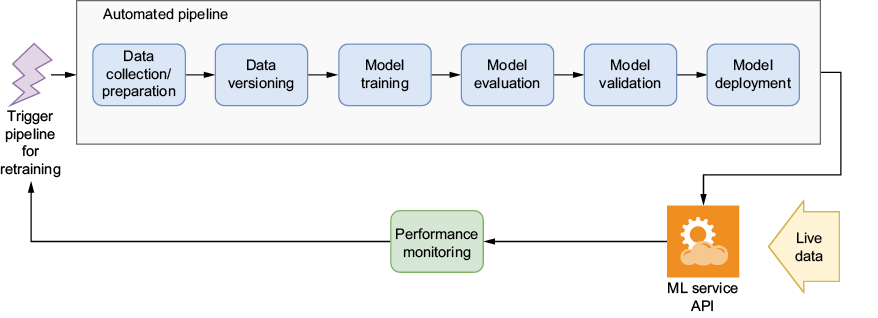
Use the life-cycle figure to trace how an orchestrated experiment pipeline becomes a fully automated production pipeline with model deployment and monitoring. section 1.1.2







