What should a supply chain produce, buy, and ship? A supply plan answers this operational question and coordinates the resulting production and logistics flow. It combines demand forecasts with constraints such as inventory targets and logistics capacity. section 2.2.2
A supply plan is not a demand forecast. Forecasts estimate expected customer demand without assuming inventory availability; supply plans translate that information into action. They can therefore differ substantially from both demand and eventual sales. section 2.2.2
An ice-cream supply decision
A planner may forecast demand for 10 pieces, plan to supply 15 as protection against uncertainty, and sell only 8. The figures 10, 15, and 8 represent forecast demand, planned supply, and actual sales—not interchangeable measures. section 2.2.2
Keep the plan responsive to changing information:
- Update short-term forecasts even when supply plans are temporarily frozen. section 6.2
- Increase the current order when a revised future forecast requires it; changing M2 demand from 75 to 100 pieces calls for 25 additional units. section 6.2
- Treat the forecast as underlying information and the supply plan as the intended action: what to buy, produce, or move. section 6.2
Figure 2.5 Demand forecast, supply plans, and sales
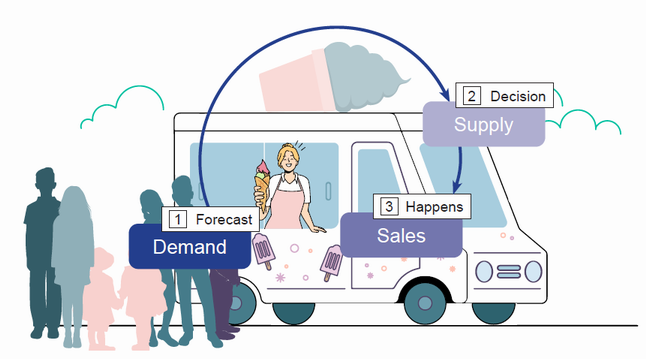
Inspect the relationship between unconstrained demand forecasts, planned supply, and actual sales. section 2.2.2
