How much stock should remain at the end of a planning period? An inventory target, or stock target, sets the desired quantity or coverage level to maintain while balancing availability against excess and obsolete inventory. section 6.2 section 6.3.1
Use the target to size replenishment orders against expected demand, current inventory, and lead time. A three-month lead time means an order placed now cannot change stock during the next three months; it can be sized to restore the target in a later period. section 6.2
Set and review the target by checking:
- Expected demand after the planning period: a target based on weeks of coverage should reflect the following period's forecast. section 6.3.1
- Service and shortage risk: higher expected demand can justify a larger safety margin when the risk of obsolete leftovers is low. section 6.3.1
- Forecast updates: revising demand for any period affected by the lead time should change the order quantity, even when the supply plan is frozen. section 6.2
- Supply-chain signal effects: applying a fixed coverage policy to an apparently small demand change can create a much larger order change upstream. section 4.2.1
Restoring the target after a three-month lead time
Starting with 150 units, expected demand leaves 70 units at the end of M3, against a 100-unit target. An order of 80 units arrives in time for M4; after 50 units of M4 demand, ending inventory returns to 100 units. If the M2 forecast rises by 25 units, increase the order by 25 units. section 6.2
Figure 6.6 Scenarios 1 and 2 (M5)
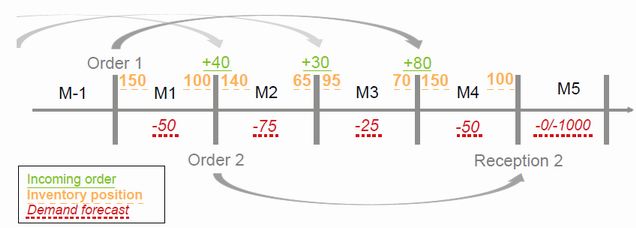
Compare zero versus very high demand after M4 to see why the appropriate stock target depends on future sales and obsolescence risk. section 6.3.1
