An inventory policy specifies how replenishment is placed and which stock target is maintained. It can determine order frequency and batch size—such as full pallets, full truckloads, or monthly orders—as well as a target expressed in weeks of supply. These choices make orders differ from the demand ultimately generated by end consumers. section 4.1
The key planning question is not simply how much demand exists, but how a change in expected demand should translate into a replenishment order while moving inventory toward its target. When downstream orders are used as the demand signal, the policy embedded in those orders can obscure the underlying consumer signal. section 4.1 section 4.2.1
Four weeks of stock can amplify a small demand change
Suppose consumer demand is steady at 100 units per week and the stock target is four weeks, or 400 units. A retailer normally orders about 100 units each week. If expected demand falls 10% to 90 units, the new target becomes 360 units. With 400 units on hand, the retailer has 40 excess units and also needs 10 fewer units for the revised forecast, so the next order falls to 50 units. A 10% demand revision therefore appears to the supplier as a 50% order reduction. section 4.2.1
Figure 4.5 As demand decreases by 10%, the new order is mechanically reduced by 50%
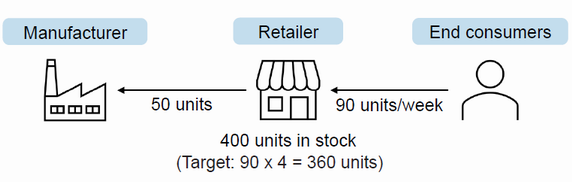
Inspect the relationship between a modest change in consumer demand, the revised inventory target, and the much larger immediate change in the replenishment order. section 4.2.1
Use inventory policies with their supply-chain effects in view:
- Separate final-client demand from incoming orders when interpreting a forecast; ordering patterns may reflect stock targets rather than consumption. section 4.1 section 4.2.1
- Set policies across inventory nodes when possible. Central control can optimize policies globally, whereas local policies can create avoidable shortages and gaming. section 4.3.1
- Share sell-out, inventory-level, and policy information with trading partners. Better information improves forecasts, but aligned supply and inventory plans enable broader optimization. section 4.3.2
A policy is therefore a coordination mechanism as well as a replenishment rule. In a multi-echelon chain, independently chosen targets can multiply order volatility upstream. Shared visibility and aligned plans make it easier to react to consumer demand rather than to another organization’s policy changes. section 4.2.1 section 4.3.2
