A lost sale is demand that would have become a purchase but could not be fulfilled, usually because the product was out of stock. Sales records therefore understate demand during shortages: they show what was supplied, not what customers wanted. Planning against sales alone can create a self-reinforcing cycle of low forecasts, low inventory, and further lost sales. section 3.0 section 6.4.1
Estimating lost sales requires reconstructing unconstrained demand. The most direct approach collects unfulfilled orders in a backlog. When that is unavailable, censor shortage periods in the forecasting data or use demand drivers unaffected by inventory, such as web traffic, weather, or store visits. The result is an estimate rather than a directly observed quantity, but better demand data supports better forecasts and revenue estimates. section 3.0 section 3.2.1
Estimating missing waffle-cone demand
An ice-cream truck normally sells one waffle cone for every five ordering customers. After running out of cones, it serves 25 customers over four hours. The observed sales show no cones, but the customer count suggests approximately five additional waffle-cone sales. Adding that estimate to the morning’s sales produces a better approximation of unconstrained daily demand. section 3.2.1
Figure 6.7 Lost sales: If M1 demand increases by 150 units (to 200 pieces), the impact on the order is only an increase of +65 units as the excess demand of M1 and M2 is lost.
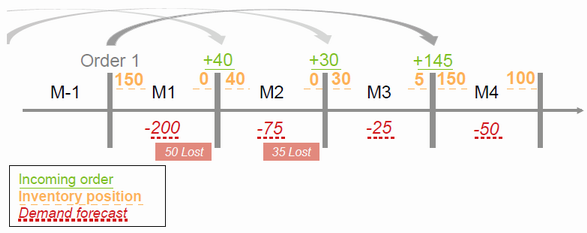
Use the figure to see how excess demand during multiple shortage months becomes lost rather than fully increasing the replenishment order. section 6.4.1
