A shortage occurs when available supply cannot satisfy customer demand. It separates what customers want from what they can actually buy, making sales an unreliable measure of demand. section 2.2.1 section 3.0
The operational question is whether zero or low sales reflect weak demand or unavailable supply. Tracking inventory alongside sales identifies periods when sales are constrained and prevents forecasts from learning the wrong lesson. section 3.2
Shortages affect planning in several connected ways:
- Forecast unconstrained demand—the requested product, quantity, and delivery date—rather than only completed sales. section 3.0
- Censor or otherwise flag out-of-stock periods so forecasting models do not interpret constrained sales as genuine low demand. section 3.2
- Use shortage information to estimate lost sales and the revenue impact of unavailable products. section 3.0
- Coordinate supply-chain decisions because speculative over-ordering can shift shortages between locations while creating excess inventory elsewhere. section 4.2.4
The empty chocolate freezer
An ice-cream seller has no chocolate ice cream, so recorded sales fall to zero even though customers still want it. Reordering from that sales forecast perpetuates the shortage: no replenishment produces no future sales. Forecasting the missing demand instead supports replenishment and customer service. section 2.2.1
Shortage gaming
When stores fear a future supply shortage, they may capture excessive stock from a central warehouse. One store accumulates inventory while others go short, turning speculative ordering into a self-fulfilling problem. section 4.2.4
Figure 3.1 Sales vs. inventory for a product sold online
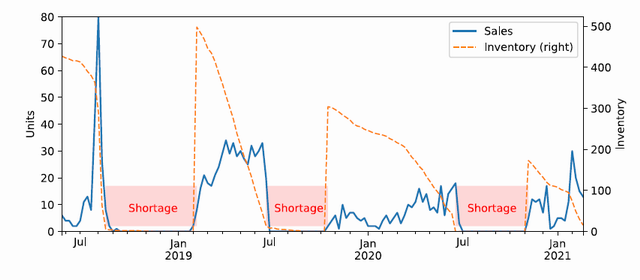
Inspect how inventory availability distinguishes observed sales from unconstrained demand over time. section 3.2
