Constrained sales are observed sales quantities limited by stock, supply, capacity, or availability. They are not a full measure of what customers wanted: sales occur only when demand and supply match. For demand planning, the key question is not “What did we sell?” but “What would customers have bought if the product had been available?” section 2.2.1 section 2.3
Forecasting constrained sales can lock a business into a shortage cycle. If chocolate ice cream is out of stock, recorded sales are zero even though children still want it. A forecast trained on those zero sales suggests no replenishment; no replenishment produces more zero sales. Forecast and inventory-target KPIs can then look perfect while the business continues to lose demand. section 2.2.1
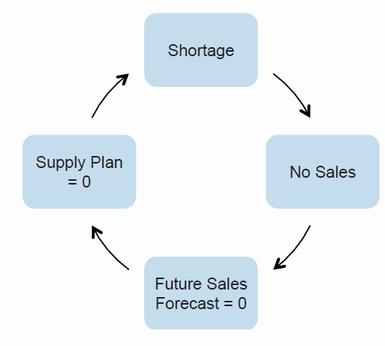
Inspect the feedback loop: stockouts suppress recorded sales, suppressed sales lower the next forecast, and the lower forecast perpetuates the stockout. section 2.2.1
Treat sales as reliable evidence of demand only when availability was sufficient. During known stockouts, sales are censored observations: low or zero sales reveal the supply constraint, not necessarily low customer interest. Track inventory alongside sales to mark periods in which demand and sales diverge, then prevent the forecasting engine from interpreting those observations as ordinary demand. section 3.2
Figure 3.1 Sales vs. inventory for a product sold online
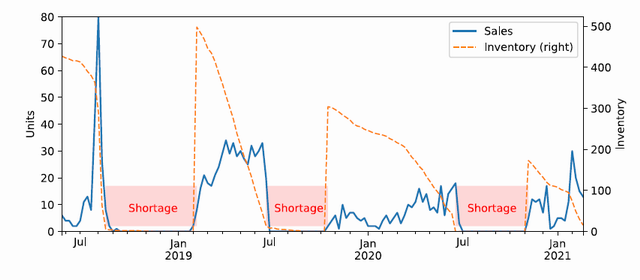
Compare inventory and sales over time to distinguish available-stock periods, where sales can represent demand, from shortage periods, where sales are constrained. section 3.2
Availability can be misleading, so investigate more than the recorded inventory balance:
- Inaccurate inventory records can conceal a real shortage even when the ERP system shows stock on hand. section 3.2
- Products left in a store but not displayed on shelves may be unavailable to customers. section 3.2
- Ultra-fresh inventory may technically remain available but fail to meet customers’ freshness expectations. section 3.2
The information loss grows across a supply chain. A retailer facing end-customer demand may record only constrained sales during shortages. Manufacturer orders add further distortion because they reflect the retailer’s inventory policy, order cadence, pallet or truck-load rules, and stock-target changes—not just consumer demand. Deliveries can be still farther from end demand when incoming orders are not captured well during shortages. section 4.1
Lost sales make the distinction especially important in B2C and fast-moving consumer goods. Customers commonly cancel rather than wait when an item is unavailable, so the missing demand may never appear as an order. Historical shortage information, lost-order collection where possible, and shortage-censoring support a less biased demand signal. B2B businesses can often retain more evidence through client orders. section 6.4.1 section 16.2.3
Planning through a shortage
Suppose a planner sees zero sales for chocolate ice cream while inventory is zero. Reordering from sales alone would imply zero future need. Instead, flag the period as a shortage, retain demand estimates from periods with stock, and forecast unconstrained demand even if the shortage is expected to continue. The resulting demand forecast can inform supply planning, budgets, and sales targets without becoming a sales or cash-flow prediction. section 2.2.1 section 6.4.1 section 2.3
