What should a demand forecast represent: what customers bought, or what they wanted to buy? Unconstrained demand records the customer’s initial request—product, quantity, and delivery date—before inventory or supply availability limits what can be sold or shipped. It is the demand signal needed for forecasting; sales are an outcome only when demand and supply can match. section 3.0 section 2.3
Sales can be a usable proxy for demand while stock is available. During shortages, however, observed sales understate customer interest: a zero sale may mean zero demand, or simply no product to sell. Forecasting those constrained sales can create a self-reinforcing out-of-stock cycle—forecast zero, replenish zero, sell zero—while accuracy and inventory-target KPIs still appear perfect. section 2.2.1 section 3.2
Ice cream and the missing waffle cones
An ice cream truck normally sells one waffle cone for every five customers. If cones run out at 2 PM but 25 customers buy ice cream afterward, the truck can estimate roughly five missed cone sales. Adding that estimate to earlier sales produces a better approximation of the day’s unconstrained cone demand than sales alone. section 3.2.1
Capture or reconstruct unconstrained demand with methods suited to the shortage situation:
- Collect and retain customer orders in a backlog when supply is unavailable, rather than treating unfilled requests as nonexistent. section 3.4
- Track out-of-stock periods and censor their low sales from forecasting input, since the model should not interpret supply-constrained sales as weak demand. section 3.2
- Use demand drivers unaffected by inventory, such as weather, web traffic, or store visits, to retrospectively estimate demand and lost sales during shortages. section 3.2.1
- Use aggregation and customer collaboration where substitution, cannibalization, or missing orders make item-level demand difficult to observe. section 3.0
Figure 3.1 Sales vs. inventory for a product sold online
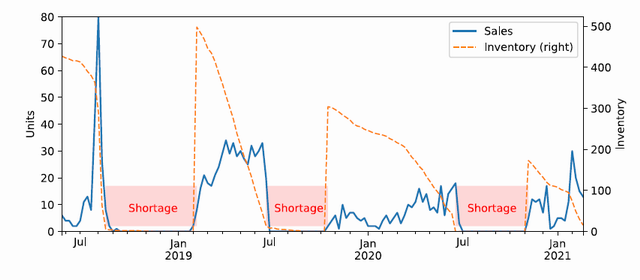
Compare inventory and sales over time to separate periods where sales reveal demand from periods where shortages conceal it. section 3.2
Keep the demand forecast separate from the supply plan, financial budget, and sales target. An unconstrained forecast can inform each of them, but each requires additional choices: constrain expected demand for shortages when estimating sales or revenue, decide supply quantities, and set incentive policies. Starting a demand forecast from a budget or target invites wishful thinking and judgmental bias. section 2.2.2 section 2.3
The signal also weakens as it moves through a supply chain. End consumers create unconstrained demand, but retailer orders reflect inventory policies, order sizes, and replenishment timing as well as sales. Deliveries received by a manufacturer may be still further removed from end demand. Seek the customer-originated signal before treating downstream orders or shipments as a forecast basis. section 4.1
Better demand data improves the baseline forecast and makes lost sales visible, although perfect collection may be impossible. Use the resulting forecast to prioritize planning and product review: historical sales alone can misclassify future importance when shortages, seasonality, promotions, or trends distort the record. section 3.0 section 13.2.1
