How can a forecast distinguish weak demand from sales suppressed by missing products? Shortage-censoring marks periods when sales are constrained by shortages so low recorded sales do not reduce the demand estimate. section 3.0 section 3.2
Use the relationship between inventory and sales to identify periods that should not represent normal demand:
- Treat sales as equivalent to demand when inventory is available. section 3.2
- Identify periods when products are out of stock and sales fall or reach zero. section 3.2
- Censor those periods in the forecasting engine rather than interpreting their low sales as low demand. section 3.2
- Inspect practical availability as well as recorded inventory: inaccurate counts, empty shelves, or unsatisfactory freshness can create shortages despite displayed stock. section 3.2
An online product with a stockout
A product sells normally while inventory is available, then sales drop to zero during a stockout. The zero-sales period reflects constrained supply, not necessarily absent customer demand, so it should be censored when estimating unconstrained demand. section 3.2
Figure 3.1 Sales vs. inventory for a product sold online
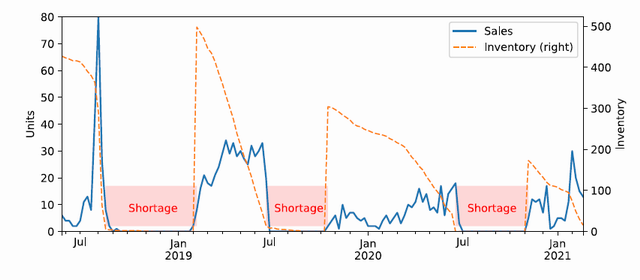
Inspect the sales-and-inventory figure to compare normal sales with the effect of product availability over time. section 3.2
