A stockout is a period when customers cannot obtain a product because no usable inventory can be supplied. During that interval, observed sales no longer represent underlying demand: sales may fall to zero even while customers still want the product. section 3.2 section 3.0
Treat stockouts as demand-data problems as well as service problems:
- Track inventory and sales together to identify periods when demand is unconstrained and periods when sales are censored by availability. section 3.2
- Exclude or censor stockout periods when training forecasts so unusually low sales do not produce an artificially low demand forecast. section 3.2
- Check apparent inventory carefully: inaccurate counts, unshelved units, or unacceptable freshness can create effective shortages despite recorded stock. section 3.2
- Account for substitution because customers may switch products, raising sales for substitutes while reducing sales for the unavailable item. section 3.3
Chocolate and vanilla ice cream
If chocolate ice cream is unavailable, some customers choose vanilla. Vanilla sales then exceed its original demand while chocolate sales fall below its demand. Forecasting sales without recognizing the stockout overstates vanilla and understates chocolate; a family-level ice-cream forecast can reduce, but not eliminate, this distortion. section 3.3
Figure 3.1 Sales vs. inventory for a product sold online
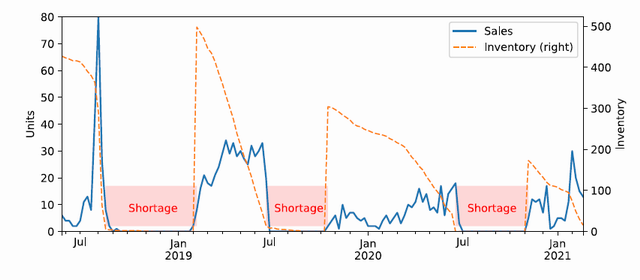
Use the sales-versus-inventory figure to inspect how product availability changes observed sales over time. section 3.2
