Projectional editing presents structured DSL content as a user interface rather than as editable plain text. The editor projects the underlying data without losing its structure, allowing users to manipulate content according to the language’s permitted form. section 1.2.2 section 1.5
A projectional editor works directly on an abstract syntax tree (AST). Unlike a textual DSL workflow, it does not depend on editing characters and then parsing them into an intermediate representation. section 1.2 section 1.2.3
Within a Domain IDE, projectional editing supports a practical development flow:
- The frontend displays DSL content in a browser and lets domain experts manipulate it through the editor. section 1.2.2
- The backend stores the structured content in a repository and exposes it through an API. section 1.2.2
- A build system feeds the stored content to a code generator, which produces parts of the Runtime. section 1.2.2
Figure 1.14 The architecture of the Domain IDE
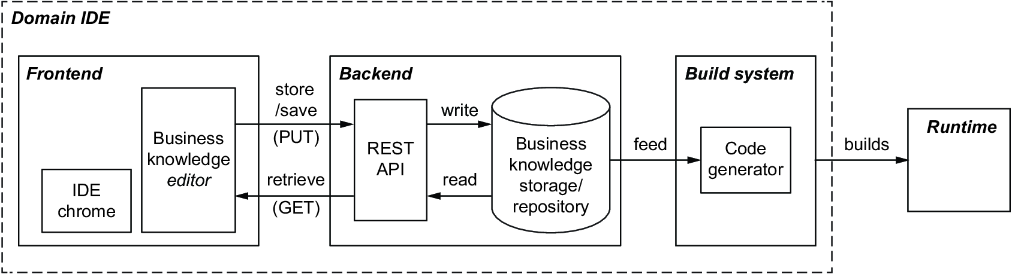
Use the architecture diagram to trace how the projectional editor connects domain experts, the repository, and generated Runtime code. section 1.2.2
