A promise is a communicated commitment about how an independent agent will behave under stated conditions. It matters when an organization cannot directly control a partner’s system: rather than command that system, it evaluates whether its stated commitments are dependable enough to authorize work. section 18.7
Reimbursement promise across organizations
A finance organization can delegate contractor reimbursements to a payment partner’s agent. The payment agent may promise to process only payments below a threshold, require a receipt, use a specified currency, and return a signed transaction record. These are commitments about behavior constrained by the receiving organization’s own policies. section 18.7
{
  "agent": "did:web:agents.partnerpay.example:reimbursement-agent",
  "promise": {
    "action": "contractor.reimbursement.pay",
    "constraints": {
      "max_amount": 250,
      "currency": "USD",
      "requires_receipt": true,
      "purpose": "process contractor reimbursements"
    },
    "audit": "signed payment receipt returned",
    "policy_framework": "cedar"
  }
}
This promise record names the action, limits such as maximum amount and currency, a required receipt and purpose, the expected audit record, and the policy framework governing the commitment. section 18.7
A promise does not transfer centralized control. Each domain retains its local policies and operational controls. The requesting side assesses the promise and the partner’s reputation, then may grant limited authority through a credential. The receiving agent still decides and acts under its own policies, while both sides log outcomes for later decisions. section 18.7 section 18.8
A usable cross-domain promise combines several layers:
- Business agreements that define responsibilities, liabilities, and audit requirements. section 18.7
- Protocols, schemas, and technical standards shared by the participating organizations. section 18.7
- Operational commitments that specify the action, limits, evidence requirements, and returned records. section 18.7
- Delegation credentials and local authorization policies that constrain what authority can actually be exercised. section 18.7 section 18.8
Figure 18.5 Cross-domain delegation in a society of agents. Two policy-limited agents collaborate across domains. The receiving agent makes promises about its future behavior, and the requesting agent assesses those promises and the partner’s reputation and then grants authority using a credential. The receiving agent operates under its own policies, and both domains log the outcome for future decisions.
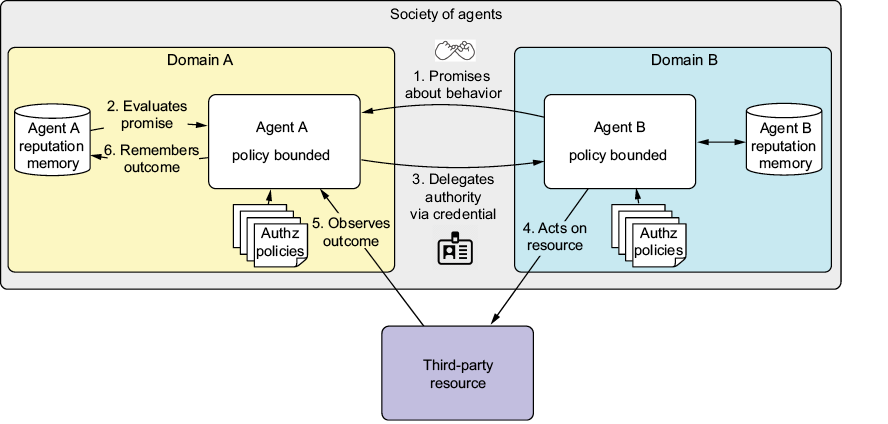
The diagram shows the decision sequence: a receiving agent states future behavior, the requester evaluates promise and reputation, grants a credential, and both domains record the result. section 18.7
Promises complement policy rather than replace it. Policies enforce behavior within a domain; promises communicate intended behavior between domains; reputation evaluates past outcomes; and credentials carry bounded delegated authority across organizational boundaries. Together, these mechanisms support a society of agents that can cooperate without a single controlling system. section 18.8
