Reputation is an assessment of an agent or organization drawn from the observed results of its previous commitments and interactions. In cross-domain delegation, it helps a requesting organization decide whether another organization’s agent should receive authority. Consistently fulfilled commitments increase trust; violated expectations can quickly remove the ability to receive delegated authority. section 18.7 section 18.8
Reputation complements, rather than replaces, authorization controls. Policies define an agent’s behavioral boundaries in its own domain, promises communicate intended behavior across domains, credentials carry delegated authority, and reputation records how those interactions turned out. Local policy still decides whether each requested action is permitted. section 18.7 section 18.8
A reputation-informed delegation decision can combine four concerns:
- Evaluate the receiving agent’s promise, including the action, limits, required evidence, and audit commitment. section 18.7
- Consider outcomes from prior interactions with that organization or agent when deciding whether to grant authority. section 18.7
- Issue narrowly constrained authority through a credential when delegation is appropriate. section 18.7 section 18.8
- Enforce the receiving agent’s local policies during execution and log the outcome for later decisions. section 18.7 section 18.8
Contractor reimbursement partner
A payment agent promises to process only contractor reimbursements below a threshold, in a specified currency, with receipts, and to return signed transaction records. The requesting organization assesses that promise alongside the partner’s reputation before delegating payment authority. If the agent repeatedly stays within those limits, later delegation becomes more acceptable; if it fails to meet expectations, its delegated authority can be curtailed. section 18.7
Figure 18.5 Cross-domain delegation in a society of agents. Two policy-limited agents collaborate across domains. The receiving agent makes promises about its future behavior, and the requesting agent assesses those promises and the partner’s reputation and then grants authority using a credential. The receiving agent operates under its own policies, and both domains log the outcome for future decisions.
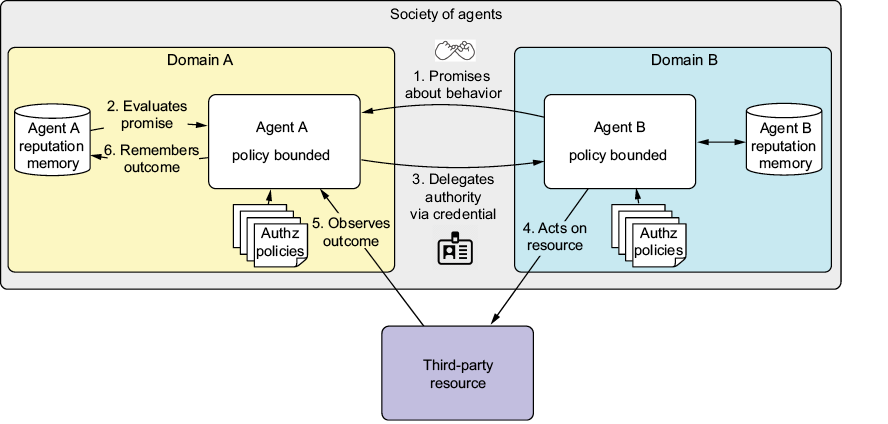
This diagram shows the feedback loop: promises and reputation inform a delegation decision, local policies constrain execution, and both domains log results that inform future trust. section 18.7
This makes reputation a dynamic input to cooperation among independent systems. It is grounded in recorded outcomes, while policy remains the enforcement mechanism that constrains actions at runtime. Together, these mechanisms support a society of agents that can collaborate without abandoning each domain’s own authorization rules. section 18.7 section 18.8
