An email can reach someone using a different service and still appear as an ordinary message. A protocol is a technical document specifying shared rules for actions such as sending email or transferring files. Services that follow the same rules can communicate, even when they are independently built. section 10.3.1
Email across services
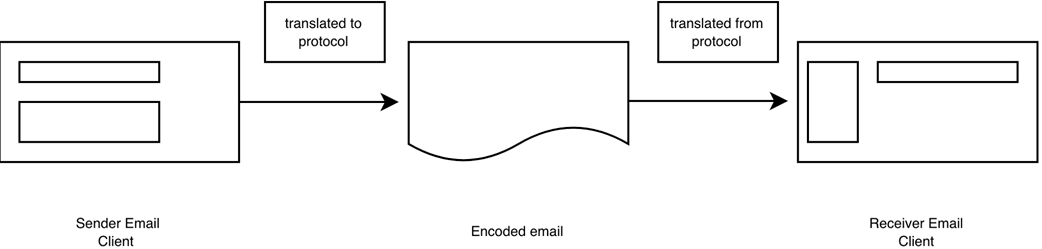
A sender can compose email with a website, while the receiver reads it in an app. The clients encode and decode the message according to shared rules; users need not know which service the other person chose. Shared protocols can support multiple services, making it easier to switch if one becomes less consumer-friendly. section 10.3.1
Figure 10.1 Simplified representation of an email to email exchange. A sender uses their client (e.g., a website) to compose the email and hits send. The composed email is encoded in a computer-friendly format, the protocol. The receiver can use any client, in this case an app, which will decode the protocol and visualize the email according to its design.
Trace how a website client encodes an email for an app client to decode. section 10.3.1



