Analysis design is a planned protocol for answering a business question. Before making pivot tables or charts, specify the analyses, possible results, and what each result means for the decision. section 3.2
A useful design makes the analytical path explicit:
- State the business question and decision it must support. section 3.0
- List the planned transformations, analyses, and possible results. section 3.2
- Define the meaning and action associated with each result before inspecting the data. section 3.2
- Revise the protocol when preprocessing reveals unavailable analyses, new ideas, or changed stakeholder priorities. section 3.2
Turn results into decisions
For a pricing decision, define the rule before calculating: if the current price exceeds the purchase price, sell; if they are equal, hold; otherwise, buy. The rule prevents the analysis from becoming an after-the-fact theory fitted to convenient results. section 3.2
Generative AI can help turn a vague request into a detailed design, but treat its suggestions as a starting point. Describe the full problem, ask follow-up questions, inspect the proposed reasoning or code, and test the result against the intended question. section 1.2.1
Figure 1.1 Recommended generative AI–supported data analysis flow
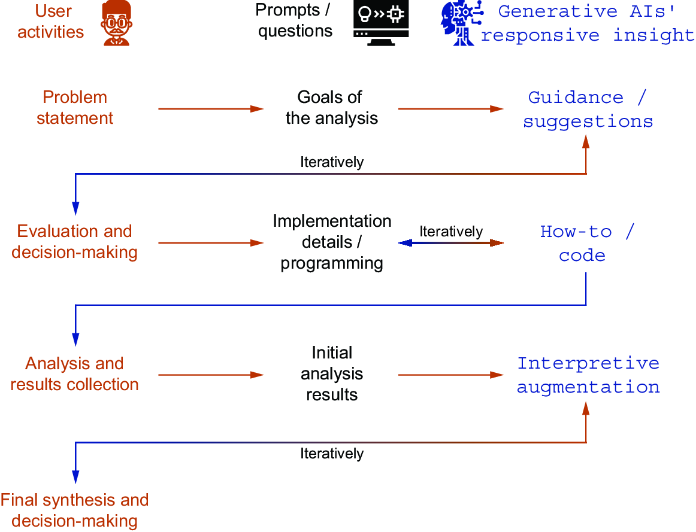
Use the recommended flow to place planning, preparation, analysis, and iterative AI assistance within one end-to-end workflow. section 1.2.1
