liveBook · Manning

Provisioning

As explained in Road to Kubernetes

Provisioning is the process of creating and initializing computing resources so they are ready to run software.

Provisioning creates and initializes a computing resource so it can run applications. A cloud provider rents part of a physical server through virtualization, letting you choose resources such as RAM and CPUs instead of renting the entire machine. section 3.1.1

Provision a virtual machine by choosing:

  • Ubuntu 22.04 LTS, or the latest LTS release. section 3.1.1
  • A nearby region, an appropriate shared-CPU plan, and a recognizable label. section 3.1.1
  • A strong root password and, preferably, SSH keys. section 3.1.1

A provisioned VM

Create a Linode labeled rk8s-vm. After a few minutes, the console displays its IP address. Connect with ssh root@<ip-address>; successful access means the machine is ready for the next deployment step. section 7.1.1

Figure 3.1 Linode VM provisioned with an IP address
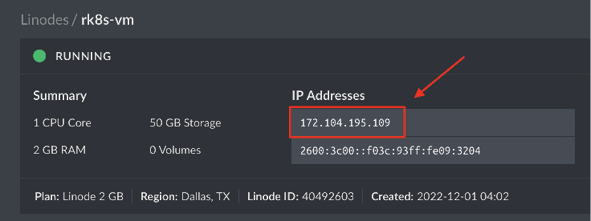
Shows a provisioned Linode VM with its assigned IP address. section 3.1.1


How Road to Kubernetes covers it

How deep it goes
Defines virtualization, walks through VM settings, and verifies SSH access, stopping before application installation or automated provisioning.
Examples
Uses Linode VMs configured with Ubuntu 22.04 LTS, regional selection, shared CPU plans, labels, passwords, SSH keys, and IP addresses.
What it assumes
Assumes no prior provisioning experience and teaches the basic cloud-rental and VM-creation workflow from the beginning.
What you can do after
Operate a provisioned virtual machine by creating it, retrieving its IP address, and verifying SSH access.
How it connects
Connects cloud computing and virtualization with virtual machines, SSH, and Docker deployment.

Also explained in

Compare how 2 books explain provisioning →

Related concepts

This explainer was generated by Manning's knowledge graph from the text of Road to Kubernetes. The section links point to the parts of the book it draws on.