liveBook · Manning

Pruning

As explained in Machine Learning for Tabular Data: XGBoost, Deep Learning, and AI

Pruning removes selected decision-tree splits after or during construction to reduce tree complexity.

Pruning removes decision-tree splits after construction, especially partitions containing too few training examples, to reduce overfitting. It produces a simpler tree that may fit training data less perfectly but can classify new examples more reliably. section 5.1

Use pruning when a fully grown tree has become too specific:

  • Work backward through the tree and remove splits enclosing very few training examples. section 5.1
  • Compare pruning with limiting growth in advance, such as imposing a maximum number of splits. section 5.1
Figure 5.3 The problem handled by a simpler decision tree, obtained by pruning or by limiting its growth
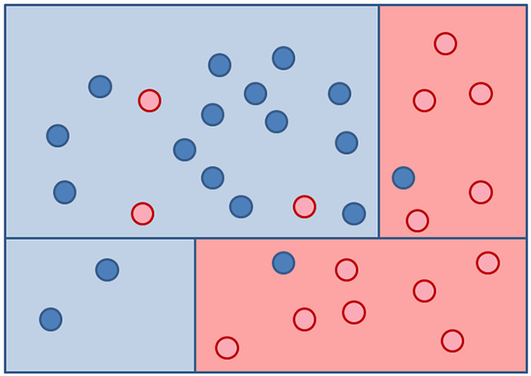
Shows how pruning produces a simpler decision tree with fewer data partitions. section 5.1


How Machine Learning for Tabular Data: XGBoost, Deep Learning, and AI covers it

How deep it goes
Explains backward split removal and its trade-off, but stops short of pruning algorithms or implementation steps.
Examples
Uses fully grown and simpler partition diagrams, including regions containing only one training case.
What it assumes
Assumes familiarity with decision-tree splits and terminal nodes while explaining overfitting through data partitions.
What you can do after
Evaluate whether to simplify an overfit tree by pruning backward or limiting growth before construction.
How it connects
Connects decision trees with splits, data partitions, terminal nodes, and overfitting.

Also explained in

Compare how 7 books explain pruning →

Related concepts

This explainer was generated by Manning's knowledge graph from the text of Machine Learning for Tabular Data: XGBoost, Deep Learning, and AI. The section links point to the parts of the book it draws on.




