Public-key cryptography solves the key-distribution problem with two related keys instead of one shared secret. Anyone can use a recipient’s public key to encrypt a message, but only the holder of the private key should decrypt it. section 1.4 section 1.4.2
A basic encrypted-message flow looks like this:
- Generate a key pair using a chosen security parameter. section 6.1
- Publish and share the public key while keeping the private key secret. section 6.1
- Encrypt plaintext with the recipient’s public key and send the resulting ciphertext. section 6.1
- Decrypt the ciphertext with the associated private key. section 1.4.2
Encryption is only one asymmetric primitive. Digital signatures use a private key to sign a message, while others use the public key, the message, and the signature to verify authenticity. Key exchange uses asymmetric mechanisms to establish a shared secret, which can then protect communication with authenticated encryption. section 1.4.3 section 5.0
Encrypted email
Instead of creating a separate shared symmetric secret for every possible sender, Alice publishes her public key. Anyone can encrypt an email to Alice; only Alice’s private key can decrypt it. section 6.1
Public-key encryption is relatively slow and can encrypt only restricted message sizes. Practical systems therefore often encrypt a fresh symmetric key with the recipient’s public key, then use that symmetric key for larger data; this combination is hybrid encryption. section 6.2 section 6.2.1
Figure 6.3 Asymmetric encryption allows one to encrypt a message (plaintext) using a recipient’s public key. The recipient can then use a different algorithm to decrypt the encrypted message (ciphertext) using a private key that’s related to the public key used previously.
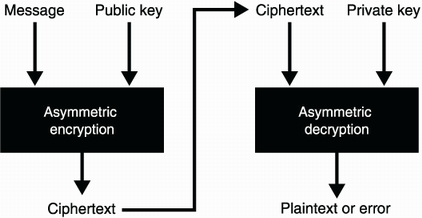
Trace the plaintext-to-ciphertext flow: a sender encrypts with the recipient’s public key, and the recipient decrypts with the related private key. section 6.1




