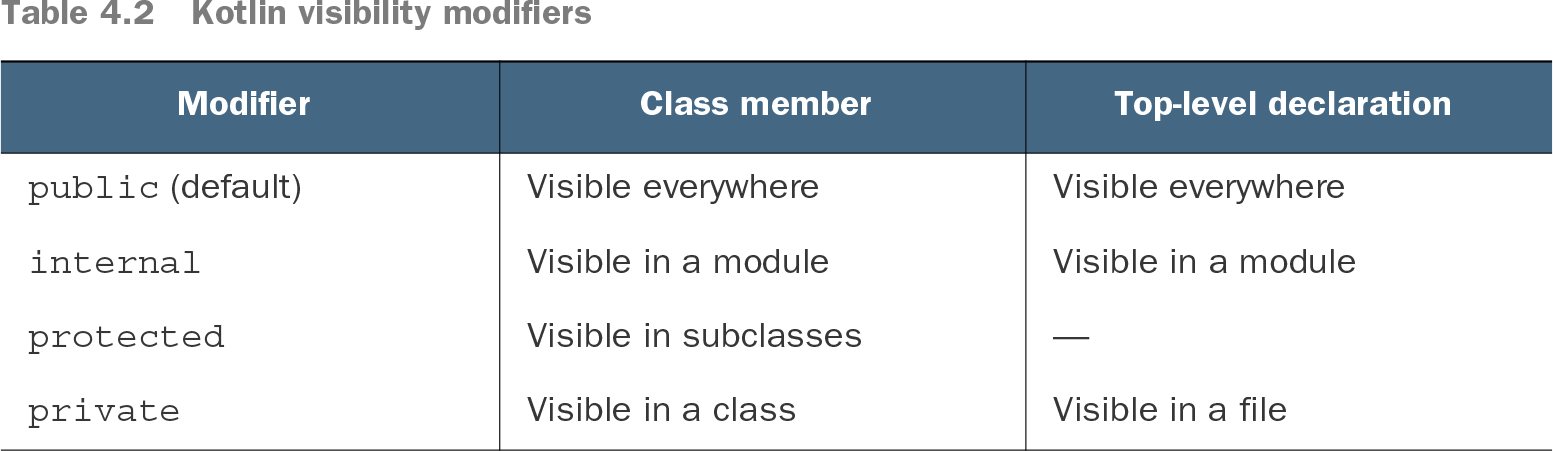
Public visibility determines which code can refer to a declaration. In Kotlin, declarations are public unless another visibility modifier is specified, making public APIs concise while supporting explicit encapsulation where needed. section 4.1.3 section 2.2
A public Kotlin class
class Person(val name: String) The class, constructor, and property are public by default. Code anywhere can create Person instances and read name. section 2.2
Use visibility modifiers to control the boundary around implementation details:
- public exposes a class member or top-level declaration everywhere. section 4.1.3
- protected exposes a member to subclasses, while private limits a member to its class or a top-level declaration to its file. section 4.1.3
- internal exposes declarations only within the compiled module, such as a Gradle source set, Maven project, or IntelliJ IDEA module. section 4.1.3
- Kotlin has no Java-style package-private visibility; packages organize namespaces rather than control access. section 4.1.3
- Library authors can enable explicit API mode with -Xexplicit-api={strict|warning} to require visibility and public API types to be declared explicitly. section 4.1.3
Public state with a private setter
class LengthCounter { var counter: Int = 0 private set fun addWord(word: String) { counter += word.length } } fun main() { val lengthCounter = LengthCounter() lengthCounter.addWord("Hi!") println(lengthCounter.counter) // 3 // lengthCounter.counter = 0 // Compile-time error } The public getter lets clients observe the counter, while the private setter prevents external code from storing an incorrect value. section 4.2.5
Table 4.2 Kotlin visibility modifiers (view table figure)
Compare Kotlin visibility for class members and top-level declarations at a glance. section 4.1.3