PVST+ is Cisco’s Per-VLAN Spanning Tree implementation. It runs a separate spanning-tree instance for every VLAN, allowing different VLANs to block different links and distribute traffic across the network. Unlike older PVST, PVST+ supports both ISL and 802.1Q trunk encapsulation. section 14.3.1
Each VLAN’s bridge ID includes the VLAN ID through Cisco’s Extended System ID. With the default priority of 32768, VLAN 1 has priority 32769 and VLAN 2 has priority 32770. The lowest bridge ID wins the root-bridge election. section 14.3.1
Balancing VLAN paths
In a topology carrying VLANs 1 and 2, PVST+ can disable one link for VLAN 1 and a different link for VLAN 2, keeping both links useful. Administrators can influence the election with commands such as `spanning-tree vlan 1 priority 24576`; valid priorities use increments of 4096. section 14.3.1
Figure 14.7 Switches in a LAN create separate spanning trees for VLANs 1 and 2 by disabling different links in each VLAN (as indicated by the dotted lines). Traffic in VLAN 1 will use different links than traffic in VLAN 2, avoiding network congestion.
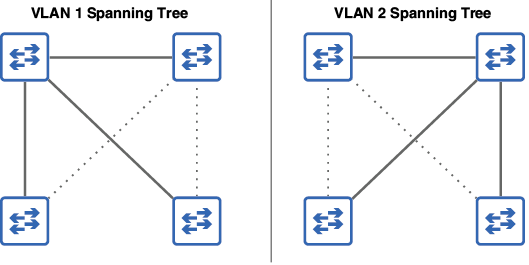
Diagram showing separate spanning trees for VLANs 1 and 2 and their different disabled links. section 14.3.1
