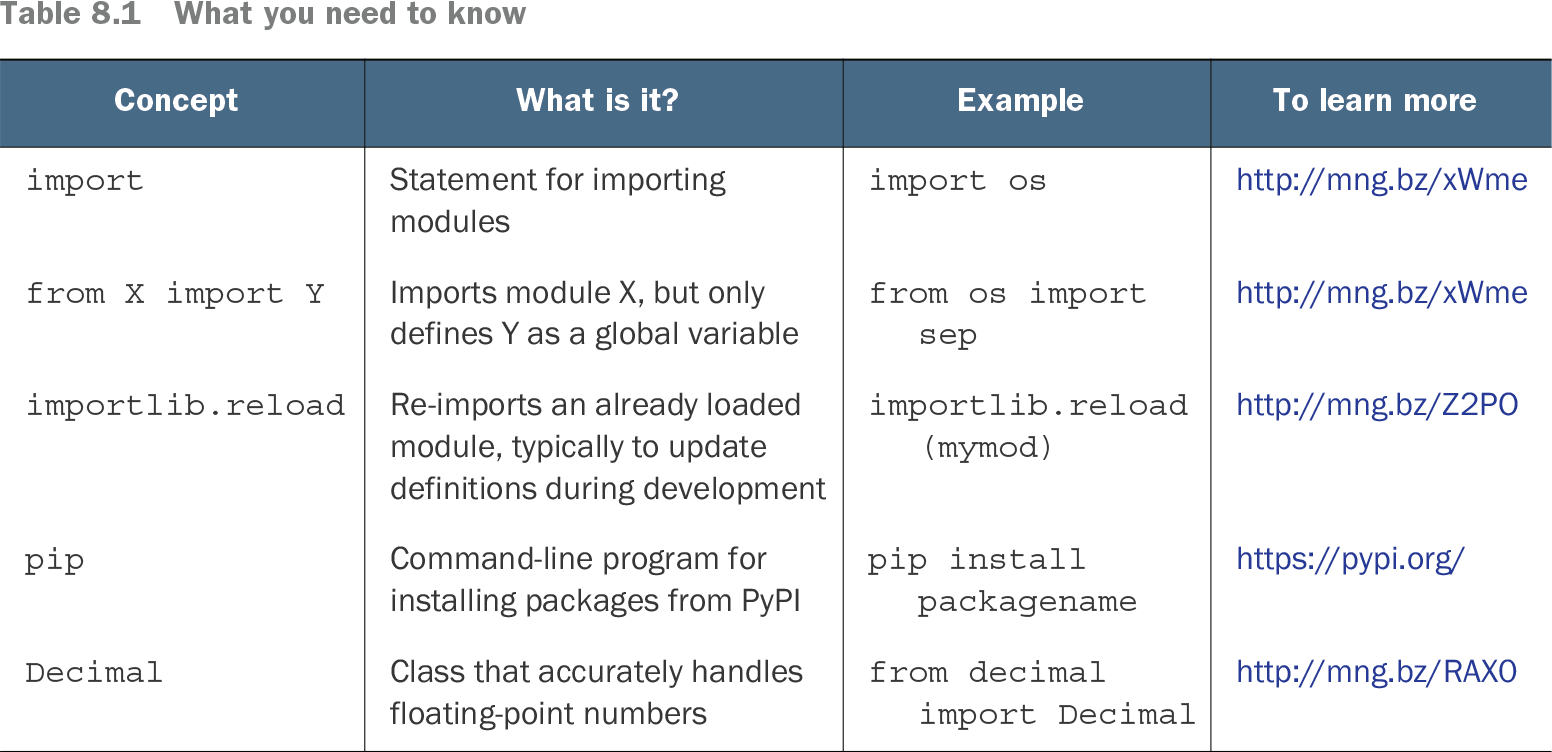
When the standard library is not enough, Python programmers can find community-contributed third-party packages on the Python Package Index (PyPI). PyPI acts as both a package repository and a distribution service, while pip provides a command-line way to install packages. section 8.0
Installing a package
A typical installation command is `pip install packagename`. After installation, the package can be imported into a Python program alongside modules from the standard library. section 8.0
PyPI’s size creates a practical selection problem: many packages may be buggy or unmaintained. Edited lists such as Awesome Python can provide a first filter before choosing a package. section 8.0
Table 8.1 What you need to know (view table figure)
| Re-imports an already loaded module, typically to update definitions during development |
|||
Use the reference table to connect PyPI with pip installation and the import statements used after packages are available. section 8.0