liveBook · Manning

Tensor

As explained in Deep Learning with Python, Third Edition

A tensor with three axes, used here for an image or feature-map representation with height, width, and depth.

A tensor is a structured array of values. In image processing, a rank-3 tensor has height, width, and depth (channels), organizing spatial data and learned features. section 8.1.1

From image to feature map

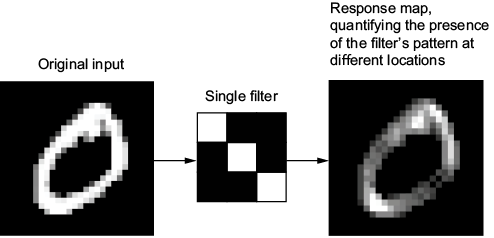
An RGB image can have shape (height, width, 3), because its depth contains red, green, and blue channels. A convolution can transform an MNIST input of shape (28, 28, 1) into (26, 26, 64): the first two axes remain spatial, while 64 output channels represent learned filters. Each channel forms a response map showing where its pattern appears. section 8.1.1

Figure 8.3 The concept of a response map: a 2D map of the presence of a pattern at different locations in an input
response map hires

Use the response-map figure to visualize a depth channel as a two-dimensional map of a pattern’s presence across image locations. section 8.1.1


How Deep Learning with Python, Third Edition covers it

How deep it goes
Defines rank-3 dimensions and channels, then demonstrates convolutional transformation without detailing tensor operations beyond feature extraction.
Examples
Uses RGB images, black-and-white MNIST inputs, and a (28, 28, 1) to (26, 26, 64) transformation.
What you can do after
Evaluate/understand how spatial axes and channels encode images and learned visual patterns.
How it connects
Connects tensors to convolution, feature maps, channels, filters, and response maps.

Also explained in

Compare how 7 books explain tensor →

Related concepts

This explainer was generated by Manning's knowledge graph from the text of Deep Learning with Python, Third Edition. The section links point to the parts of the book it draws on.




