Q-learning is a reinforcement-learning approach for choosing the next-best action from a known state. It assigns each state–action pair a quality value, then learns those values by trial and error: rewards reinforce useful choices, while failed attempts expose poor ones. A learned Q-table acts as a lookup table or policy for selecting actions. section 11.1.1 section 11.6
A small discrete environment makes the mechanism visible. In Frozen Lake, an agent moves up, down, left, or right across a 4-by-4 grid. Reaching the goal earns a reward; falling into a hole ends the episode with a negative reward. The agent must discover a reliable route while balancing random exploration against actions currently rated best. section 11.1.1
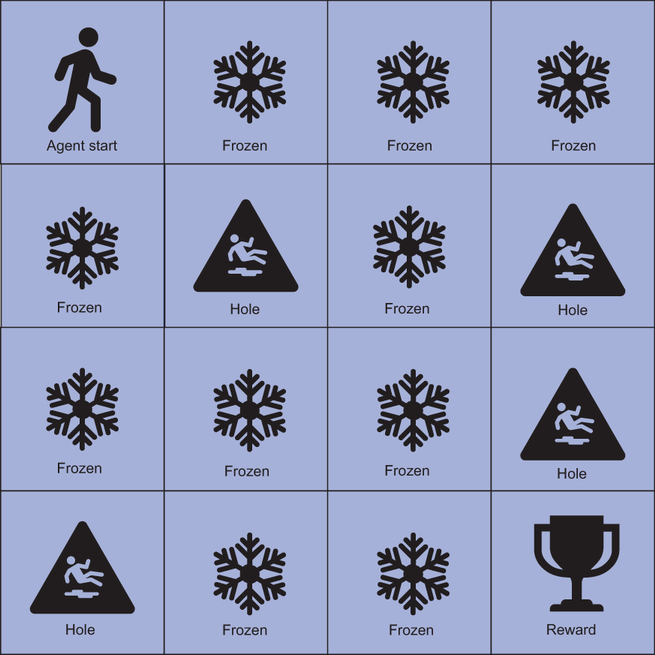
Use the grid layout to connect states, available moves, terminal holes, and the rewarded goal before constructing the table. section 11.1.1
A table-based agent can be built in a short loop:
- Create the Gym environment, then read its action-space and observation-space sizes. section 11.1.1
- Initialize a zero-filled Q-table with one row per state and one column per action. section 11.1.1
- Choose either the highest-valued action or a random action according to epsilon exploration. section 11.1.1
- After each step, update the selected table value toward immediate reward plus the discounted best value of the next state. section 11.1.1
- Repeat episodes, decay epsilon, inspect average reward and the resulting table, then run greedy evaluation episodes. section 11.1.1
Frozen Lake Q-table
With 16 grid states and four movement actions, the initial Q-table contains zeros. Training for repeated episodes changes entries only after observed transitions and rewards. At evaluation time, choosing argmax(Q[state, :]) removes random exploration and follows the table’s preferred move at each state. section 11.1.1
Q-tables fit small, discrete state spaces but become impractical as environments grow more complex. Deep Q-learning, or DQN, replaces the table with a neural network trained using the Q-learning equation as a target. This extends the approach to environments such as Atari games, CartPole, and Lunar Lander, using stored experiences and replayed batches to update the model. section 11.2 section 11.5
Reward accumulation can show gradual improvement, but complex deep reinforcement learning still faces challenges such as multitask or generalized learning. Experiment with environments, episode counts, exploration schedules, and parameter settings rather than treating one run as a universal result. section 11.4.1 section 11.5


