QA-LoRA combines low-rank adaptation with quantization to fine-tune large language models using fewer GPUs while keeping the adapted weights quantized for efficient deployment. section 8.3.5
Unlike approaches that quantize after training, QA-LoRA integrates quantization into adaptation. This balances low-bit efficiency with model accuracy and avoids a separate posttraining quantization step. section 8.3 section 8.3.5
Its implementation is organized around three design choices:
- Converts pretrained weights W into a low-bit representation before or during fine-tuning, reducing the memory required for adaptation. section 8.3.5
- Partitions weight matrices into groups and applies quantization and low-rank adaptation at granular levels, allowing each group to receive tailored treatment. section 8.3.5
- Keeps the combined weights quantized after adaptation, supporting computationally efficient inference without posttraining quantization. section 8.3.5
QA-LoRA occupies a different point in the parameter-efficient fine-tuning trade-off space. LoRA supplies the simpler low-rank baseline; QLoRA adds quantization with NF4, double quantization, and paged optimizers; QA-LoRA emphasizes group-wise quantization and adaptation; LQ-LoRA decomposes weights into high-precision low-rank and quantized components. section 8.3 section 8.3.7
Figure 8.16 The goal of QA-LoRA. Unlike previous adaptation techniques, such as LoRA and QLoRA, this method is more computationally effective during both the fine-tuning and inference phases. Importantly, it avoids a decrease in accuracy as it eliminates the need for posttraining quantization. Although the figure presents int4 quantization, QA-LoRA is adaptable to both int3 and int2. Image is taken from [4].
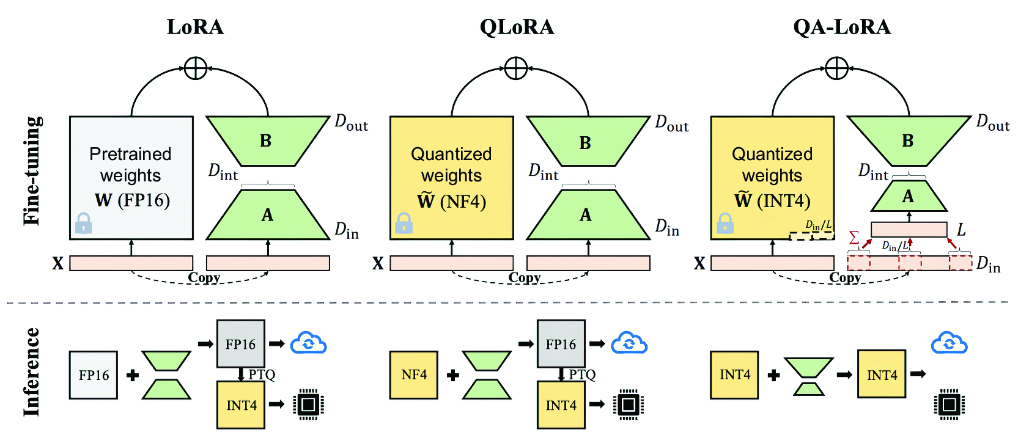
Use the comparison figure to contrast QA-LoRA with LoRA and QLoRA across fine-tuning efficiency, inference efficiency, quantization level, and posttraining quantization requirements. section 8.3.5
