A quality attribute is a measurable, desirable property of an application, defined through specific scenarios. Unlike a functional requirement, which describes a capability, a quality attribute describes how well the application operates or how easily it can be changed and deployed. Architecture helps satisfy these properties. section 3.1.3 section 5.0
Quality attributes include runtime properties such as availability, performance, and security, and development-time properties such as ease and speed of development and deployment. A performance requirement, for example, might specify 233 create-order requests per second with an average response time of 356 milliseconds. section 3.5 section 3.1.3
Figure 3.3 An example availability scenario, which specifies that the application continues to handle requests when a service instance, such as the FTGO application’s Order Service, fails
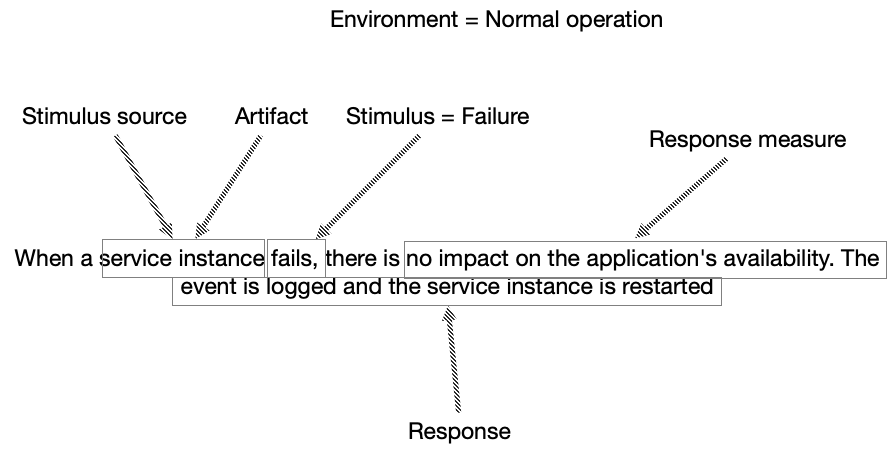
An availability scenario makes the desired behavior concrete: the application continues handling requests when a service instance fails. section 3.1.3
Fast flow—the continuous delivery of small changes and rapid feedback—depends on five related attributes: section 5.0
Design for each attribute according to the problem it addresses:
- Modifiability: make application changes easier through cohesive, loosely coupled design. section 5.7
- Evolvability: make technology upgrades easier; in large applications, separate component decisions can support incremental upgrades. section 5.7
- Testability: verify changes quickly and reliably through modular, loosely coupled, deterministic design. section 5.7
- Deployability: make production deployment fast and reliable, with automation and rollback when problems occur. section 5.7
- Observability: understand application and user behavior, supporting deployment safety and production feedback. section 5.7
Component architecture affects how well a large application meets these attributes. Independently deployable microservices can support fast flow, but distributed operations introduce latency, partial failure, and eventual consistency. Poorly designed, tightly coupled services can become a distributed monolith. Choose the simplest architecture that solves the actual quality problems, and evolve it as needed. section 5.7 section 7.7 section 3.5

