A quantum amplitude is the value attached to one possible measurement outcome in a quantum state. Unlike an ordinary probability, it has both magnitude and direction: amplitudes are conveniently represented as complex numbers, or visually as arrows. The probability of an outcome is the squared magnitude of its amplitude; direction does not directly determine how often that outcome appears in repeated measurements. section 2.2.2 section 1.4.2
A one-qubit state has two amplitudes, one for outcome 0 and one for outcome 1. An n-qubit state has one complex amplitude for each of its 2ⁿ binary outcomes. Valid states are normalized: the sum of every amplitude’s squared magnitude equals 1. This makes the squared magnitudes a complete probability distribution for measurement. section 3.1 section 4.2.2
A “clock” representation of a quantum state and the unit color wheel
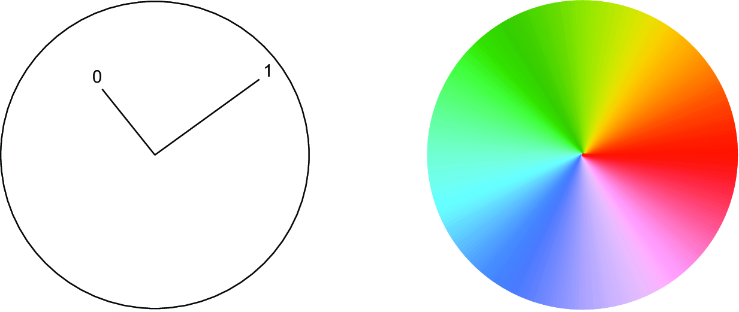
Use the clock view to distinguish an amplitude’s length from its direction; both describe the state, while squared length supplies the measurement probability. section 3.1.1
Represent amplitudes in Python as complex-number lists:
- Store a single-qubit state as two entries, where each index is its corresponding outcome. section 3.1.3
- Use abs(amplitude)**2 to calculate an outcome probability, and verify that their sum is 1. section 3.1.3
- Use atan2(amplitude.imag, amplitude.real) when a state table needs an amplitude direction in radians. section 3.1.3
- For multiple qubits, use a list of 2ⁿ complex values indexed by the integer form of each outcome. section 4.2.2
Encoding a one-qubit state
The list [sqrt(0.3), -sqrt(0.7)] assigns amplitudes to outcomes 0 and 1. Their squared magnitudes are 0.3 and 0.7, so repeated measurement samples 0 with probability 0.3 and 1 with probability 0.7. The negative second amplitude has a direction of 180°, showing information that probabilities alone omit. section 3.1.3
Quantum gates operate by recombining pairs of amplitudes while preserving the pair’s combined probability. Computation therefore changes amplitudes rather than merely selecting a result. For optimization-style tasks, amplitude amplification aims to raise the probability of desired outcomes; measurement then samples one binary-string outcome from the resulting distribution. section 3.2 section 2.5
Uniform amplitudes across three qubits
Starting from [1, 0, 0, 0, 0, 0, 0, 0], applying a Hadamard gate to each of three qubits produces eight equal real amplitudes, approximately 0.35355. Equal magnitudes give every three-bit outcome the same probability. section 4.3.4

