Quantum parallelism is the computational effect of applying one quantum instruction across many affected amplitude pairs at once. Superposition supplies amplitudes for multiple possible outcomes, and a gate changes the relevant pairs simultaneously in the quantum system. A useful developer analogy is unlimited SIMD: one instruction follows the same pairwise rule over all applicable data, rather than iterating through a limited vector width. section 1.3 section 1.3.1 section 4.3.3
The parallel work is not a collection of independently stored classical values that can all be read afterward. The values are internal amplitudes whose changes determine outcome probabilities. Measurement then samples outcomes according to those probabilities, so an algorithm must shape the state toward information that can be usefully observed. section 1.3.1 section 1.6 section 12.1.2
Think of a gate transformation as a repeated butterfly operation:
- Choose pairs of amplitudes from the target qubit and any control-qubit conditions. section 12.3
- Recombine each selected pair with the gate’s two-by-two matrix formula. section 12.3
- Apply that same recombination across every selected pair simultaneously on quantum hardware; a simulator instead visits pairs one at a time. section 4.3.3
- Use controls to restrict which pairs change when applying every pairwise operation would create unwanted effects. section 1.3.1 section 12.3
Simulating an X gate on three qubits
A state simulator can model the pairwise rule directly. For each pair of indexes generated for target qubit 0, it reads amplitudes x and y and writes the matrix result back to those two positions. With an X gate, each selected pair is swapped. The simulator loop makes the pairing visible, but its sequential processing is only a model of the simultaneous gate action. section 4.3.3 section 12.3
Figure 4.22 Butterfly diagrams of the pairs of outcomes in a three-qubit system for targets 0, 1, and 2
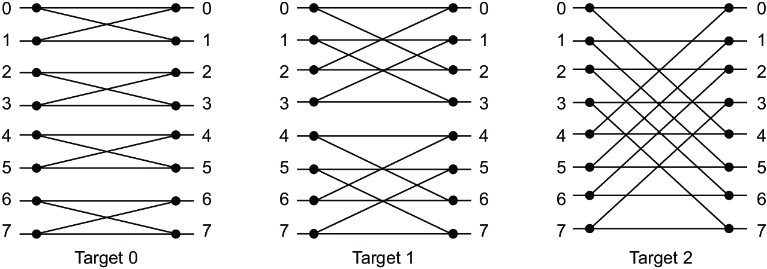
Compare the butterfly pairings for targets 0, 1, and 2 to see that the target qubit determines which amplitude indexes are recombined. section 4.3.3
Parallel pair transformations support quantum advantage only when a problem aligns with the structured operations that gates can perform. Useful computation patterns combine these transformations with measurement for sampling distributions, searching for desired outcomes, or estimating outcome probabilities. Quantum Fourier transforms, geometric-sequence state encoding, and Grover-style amplification illustrate different ways to exploit the pattern. section 1.6 section 12.1.2
