A quantum system is a collection of qubits whose state describes possible measurement outcomes, while quantum transformations change that state before measurement. An n-qubit system has 2^n possible binary-string outcomes, one digit per qubit. section 1.4.3 section 2.2.1
Use three related models to reason about a quantum system:
- State: represent an n-qubit system with 2^n complex amplitudes whose squared magnitudes sum to 1; state tables connect this representation to probabilities and programs. section 4.6
- Evolution: apply quantum gates to target qubits, optionally controlled by other qubits; transformations recombine amplitude pairs according to the gate formula. section 4.6
- Measurement: obtain one binary string from the system's probability distribution; measuring all qubits at the end gives an n-character result. section 1.4.3 section 2.2.1
- Registers: group qubits to encode logical variables such as item selections, values, or weights. section 2.2.1
Two- and three-qubit outcomes
A two-qubit system can produce 00, 01, 10, or 11, interpreted as integers 0 through 3. A three-qubit computation has eight possible outcomes; one run might measure 100, interpreted as 4. The measured string is a single sampled result, not the full probability distribution. section 1.4.3 section 2.2.1
Figure 1.9 The steps of a quantum computation using quantum bits (qubits). The example in the diagram uses three qubits, so there are eight possible outcomes, each with a certain measurement probability represented by the filled part of the sectors. When a measurement is performed, we get one result according to the probabilities. The result is interpreted as a binary string.
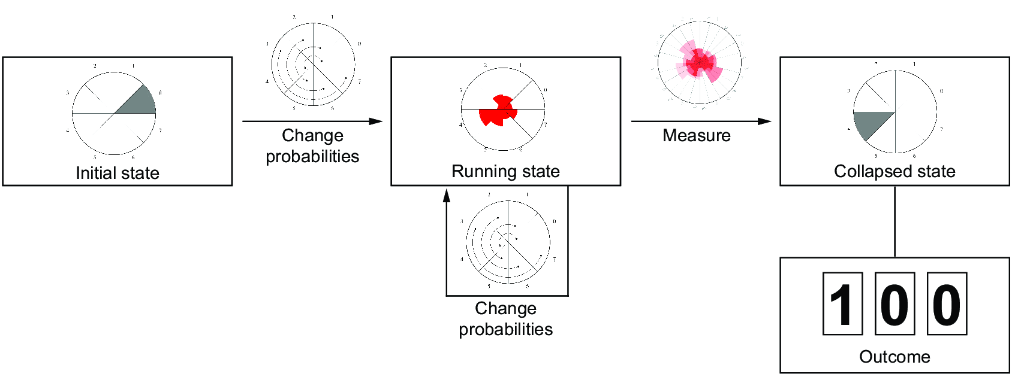
Inspect the computation model visually: a three-qubit system carries probabilities across eight binary-string outcomes, then measurement selects one result. section 1.4.3
