A customer asks, “When are you open?” They need the hours, not a series of follow-up questions. Question-answering bots, also called FAQ bots, answer a user’s question directly and usually end the interaction there. They work especially well when there are relatively few frequently asked questions. section 1.1 section 2.1
A common design maps a user utterance to an intent, then gives that intent’s response. An utterance is what the user says; an intent groups questions with similar meanings; a response is the answer. “What time are you open?” and “What are your hours?” can share a store-hours intent and receive the same answer. “What cakes do you sell?” belongs to a different intent. section 2.1.2
Figure 2.2 Question-answering bots map user utterances to intents, which map to answers.
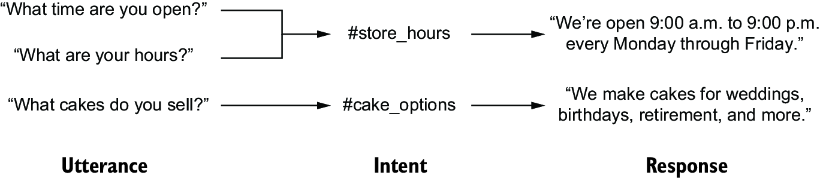
The diagram shows the short path from differently worded questions through an intent to an answer. section 2.1.2
Choose the answer design to fit the question:
- Use a predefined response when the answer should stay the same. Train the intent with example questions, then edit and control the wording of its answer. section 2.1 section 2.1.2
- Use a dynamic response when the answer must change with information in the question. An API can also supply additional user context, although an FAQ bot may need no API at all. section 2.1 section 1.1.3
An answer is not always a completed task
A customer asking about cake prices can receive a concise price and delivery-fee answer. A customer trying to order a cake needs more: a bot that only explains how to place an order leaves the transaction undone. Likewise, telling someone how to check an account balance does not give them their balance. Use a process-oriented bot when the goal requires action, and route the user when a specialist is needed. section 2.1.2 section 2.2 section 8.1 section 1.1
Start small, then judge success by whether answers are prompt and accurate without unnecessary follow-up. Add example questions when users phrase familiar requests differently, and expand beyond FAQs when users need tasks completed. Predefined answers provide wording control but become harder to manage as intents multiply; generative AI can help with broader requests but brings cost, latency, and hallucination risk. section 2.1.2 section 3.0 section 7.1



