Quicksort sorts by choosing a pivot, partitioning values around it, and recursively sorting the sublists on either side. The pivot reaches its final position during partitioning. section 15.6
Apply the algorithm in this sequence:
- Choose a pivot, move it aside, and scan inward with indexes i and j. section 15.6.2
- Swap out-of-place values while i remains left of j, then restore the pivot between the two sublists. section 15.6.2
- Stop for sublists of size zero or one; swap a reversed pair of size two; otherwise recurse on both sides. section 15.6
Python implementation
A Quicksort class separates swapping, partitioning, recursive sorting, and verification. Its demonstration sorts twenty random values in place and reports success after checking adjacent pairs. section 15.6.3
Figure 15.12 Choosing 52 (circled) to be the pivot value and then partitioning the list into two sublists. Variables i and j are list indexes. After partitioning, all values to the left of 52 are less than or equal to it, and all values to the right of 52 are greater. The two boxed sublists on either side of the pivot are now ready to be recursively quicksorted.
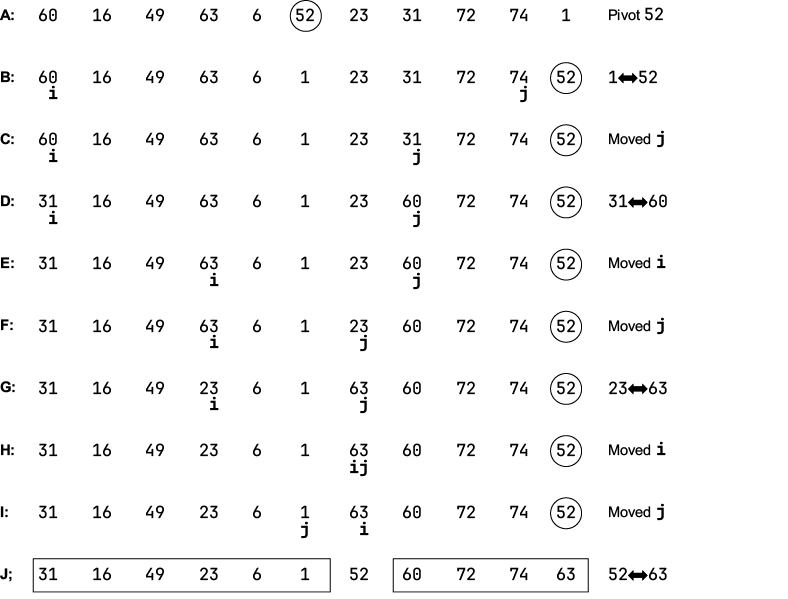
Follow the pivot 52 through index scans and swaps to see how one list becomes two recursively sortable sublists. section 15.6.2


