RabbitMQ is an open-source distributed message broker for decoupling producers and consumers. It supports point-to-point queues, publish-subscribe messaging, and request-reply interactions. section 5.3.1
RabbitMQ’s architecture and messaging model provide:
- Queues deliver a message to a single consumer and remove it after consumption. section 5.3.1
- Exchanges route producer messages to queues using bindings, routing rules, and message content. section 5.3.1
- Request-reply messaging correlates responses with requests through reply queues and correlation IDs. section 5.3.1
- Protocols include AMQP, STOMP, and MQTT, supporting different integration requirements. section 5.3.1
Microservice request and response
A client sends a request through RabbitMQ, identifies its reply queue, and includes a correlation ID. A server processes the request and publishes a response with the same ID, allowing the client to match the response to the original request. section 5.3.1
Figure 5.12 RabbitMQ architecture
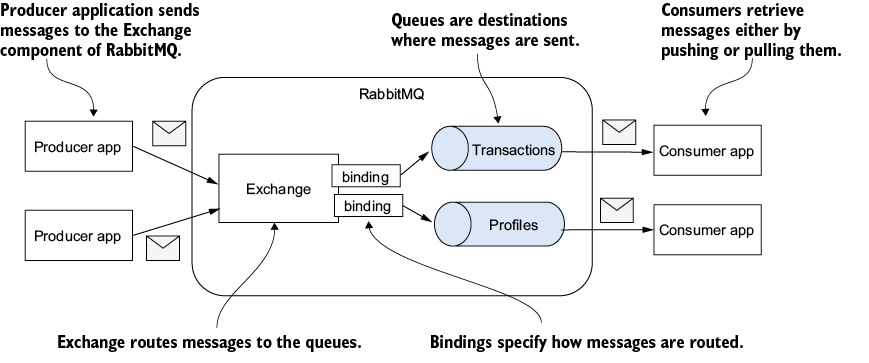
The architecture diagram helps trace how producers send messages to exchanges, which route them to queues consumed by decoupled clients. section 5.3.1




