liveBook · Manning

Race condition

As explained in Rust Servers, Services, and Apps

A race condition is a concurrency defect in which the result depends on the timing or interleaving of operations.

A race condition is a concurrency defect caused by unpredictable operation timing: one thread reads shared data while another updates it during the first thread’s computation. section 10.1

In a multithreaded web server, request-handling threads can execute in unpredictable orders, making shared-memory access harder to design safely. Rust’s thread-safety guarantees prevent race conditions and related classes of bugs. section 1.3.2 section 10.1

Interleaved shared-data access

Thread A reads a value and begins computing with it. Before Thread A finishes, Thread B updates that value. Thread A may therefore produce a result based on stale data. section 10.1
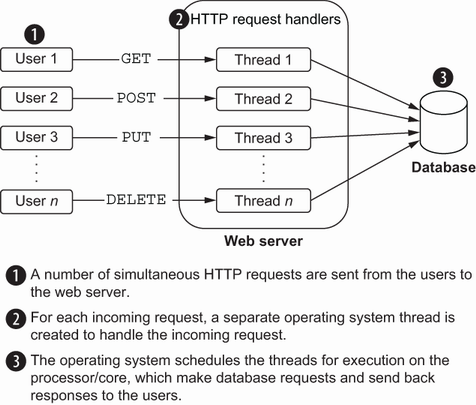
Figure 10.3 Multithreading in HTTP request processing

Relate race conditions to the distribution of HTTP request handling across multiple operating-system threads. section 10.1


How Rust Servers, Services, and Apps covers it

How deep it goes
Defines the defect through a read-update interleaving but does not develop mitigation techniques.
Examples
Uses a thread reading memory while another thread updates the same value, alongside multithreaded HTTP request processing.
What it assumes
Assumes familiarity with threads and memory access while illustrating the defect through a basic concurrent execution scenario.
What you can do after
Understand why multithreaded server programs require careful design around shared data and unpredictable execution.
How it connects
Connects race conditions with concurrency, multithreading, shared memory, deadlocks, and asynchronous programming.

Also explained in

Compare how 20 books explain race condition →

Related concepts

This explainer was generated by Manning's knowledge graph from the text of Rust Servers, Services, and Apps. The section links point to the parts of the book it draws on.

















