RAGOps is the operational discipline of building, deploying, and sustaining retrieval-augmented generation (RAG) pipelines in production. It keeps knowledge stores fresh, retrieval accurate, and generated output aligned with application quality standards. section 9.3.5
RAGOps connects two workflows: runtime query processing and data-management indexing. The first manages the path from a user query to a validated response; the second maintains and evaluates the knowledge assets that retrieval depends on. section 9.3.5
Figure 9.5 RAGOps workflows for the query-processing pipeline and the data-management pipeline in production RAG systems
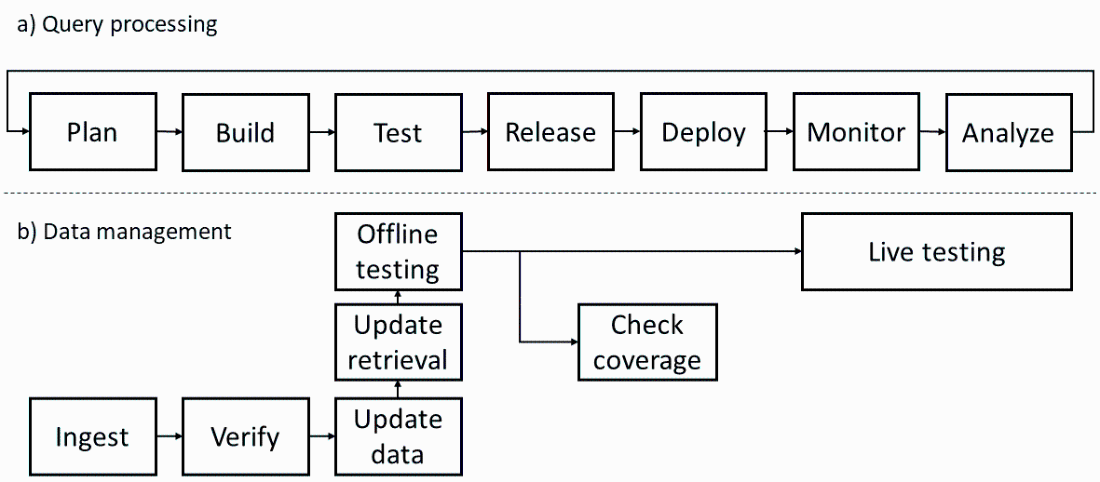
Compare the production query-processing and data-management workflows. section 9.3.5
The runtime workflow adapts planning, building, testing, deployment, and monitoring to the query path. It automates query reformulation, embedding generation, retrieval, reranking, prompt synthesis, and output validation. Telemetry tracks latency, token consumption, and generation faithfulness; regression traces feed automated evaluation suites. section 9.3.5
The data-management workflow maintains knowledge bases, vector stores, and knowledge graphs through five stages:
- Ingest and verify multi-source documents for formatting, completeness, recency, and access-control permissions. section 9.3.5
- Chunk and index content, compute embeddings, and incrementally update changed records to reduce staleness. section 9.3.5
- Evaluate candidate indexes offline against golden test sets using retrieval precision, recall, and semantic similarity. section 9.3.5
- Validate benchmark coverage against evolving vocabulary, multi-hop queries, and real-world user intent. section 9.3.5
- Release index updates through A/B tests or canaries, comparing retrieval precision and generation groundedness against production traffic. section 9.3.5
Releasing an index update
Evaluate a candidate index against a golden test set, then check that the test queries reflect current domain vocabulary and user intent. Release the update through a canary or A/B test and compare retrieval precision and generation groundedness with production traffic. section 9.3.5
In operation, monitor stale-document rate, index freshness lag, and embedding drift after corpus or embedding-model updates, alongside retriever and generator metrics. These signals complement pre-deployment evaluation with evidence from the running system. section 9.3.5
RAGOps focuses on indexing and retrieval pipelines within context operations. PromptOps instead governs prompt templates, versioning, and evaluation; AgentOps governs tools, memory, state, and orchestration. These operational labels are emerging, and responsibilities may be distributed across platform, application, data, security, and domain teams. section 9.3.2
