RAID 1 mirrors data byte for byte across multiple disks, requiring at least two devices. It reduces the impact of a hard-disk crash, but mirroring is not a complete PostgreSQL protection strategy. section 9.1
The tempting redundancy plan
A PostgreSQL installation uses RAID 1 and a standby server with streaming replication. This appears to provide double redundancy, but filesystem corruption is copied identically to every mirrored disk. RAID therefore cannot protect against damaged logical file structures or damaged data. section 9.1
Use RAID 1 with these limits in mind:
- Expect protection from a disk failure, not from filesystem corruption. section 9.1
- Treat mirrored disks as identical copies, so corrupted data can become duplicated corruption. section 9.1
- Do not assume file-level snapshots are automatically safe for PostgreSQL; WAL and data files must remain synchronized. section 9.1
Figure 9.1 A PostgreSQL installation layout demonstrating the double physical redundancy of having a standby server but also RAID1 mirrored disks in each of the servers.
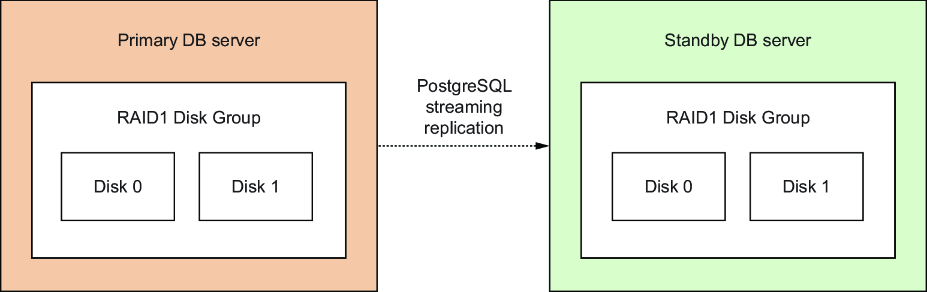
Compare the mirrored disks on each PostgreSQL server with the additional standby server, and see why physical redundancy can still leave shared failure modes. section 9.1

