Random search is a model-free hyperparameter optimization method that samples configurations from a defined search space until the allocated search budget is exhausted. It makes no assumptions about training code and ignores correlations between trials. section 5.2.2
A practical random-search workflow consists of:
- Define ranges or distributions for each hyperparameter, such as learning rate [0.001, 0.1] and batch size [10, 100]. section 5.2.2
- Set a search budget, such as 100 trials, and independently sample a configuration for each trial. section 5.2.2
- Train and evaluate the model for every sampled configuration, then use the resulting trial outcomes to identify a strong configuration. section 5.2.2 section 5.4.1
Unlike grid search, random search does not enumerate a Cartesian product. This avoids grid search’s exponential evaluation growth as dimensions expand and can devote more trials to promising regions rather than distributing trials uniformly across all combinations. section 5.2.2
The method is straightforward to integrate into an HPO service because trials are independent. Hyperopt provides random search alongside TPE and adaptive TPE, and supports serial or parallel execution through workers coordinated by a central database or through Spark. section 5.4.1
Budgeted classifier search
A search can sample classifier_type from naive_bayes, svm, and dtree, while giving each classifier its own parameters. The objective function reads the sampled arguments, trains the model, and returns its evaluation result; the optimizer then repeats this process within the trial limit. section 5.4.1
Figure 5.4 Comparison of grid search and random search for minimizing a function with one important and one unimportant parameter. (Source: Figure 1.1. of “Hyperparameter Optimization,” by Matthias Feurer and Frank Hutter, in AutoML: Methods, Systems, Challenges, eds. Frank Hutter, Lars Kotthoff, and Joaquin Vanschoren; Springer, 2019. www.automl.org/wp-content/uploads/2019/05/AutoML_Book_Chapter1.pdf)
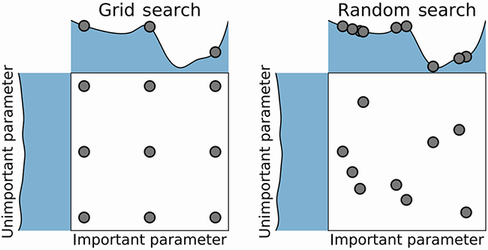
Compare how random sampling behaves against grid search when one parameter matters more than another. section 5.2.2

