Randomness describes variation in outcomes when the same process is repeated. A random variable represents those possible outcomes numerically, with probabilities assigned to discrete outcomes or densities to continuous ones. section 2.2.1 section 2.1.1
Probabilistic modeling uses two complementary interpretations. Physical probability treats a value as the long-run proportion produced by a repeatable process; subjective probability treats it as belief or uncertainty. Many models nevertheless represent the data-generating process as deterministic, placing randomness in incomplete knowledge rather than in the underlying system. section 2.2.1 section 2.4 section 2.4.1
Model randomness operationally by:
- Defining a random variable and its possible outcomes, such as {1, 2, 3} for a three-sided die or {0, 1} for a coin flip. section 2.1.1
- Choosing a probability interpretation and a distribution suited to the phenomenon, including distributions for counts, bell curves, or waiting times. section 2.5
- Generate samples from random processes for population proxies, expectation estimates, and inference; Pyro supplies distribution primitives and Monte Carlo methods support estimation. section 2.5
Figure 2.1 Three-sided dice each represent a random variable with three discrete outcomes.
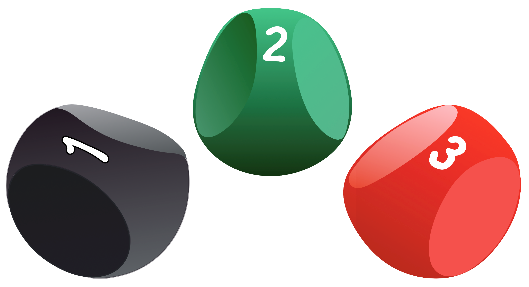
Three-sided dice provide a compact visual model of a random variable with three discrete outcomes. section 2.1.1




