Encoding translates information into a numerical or structured form that an algorithm can process. For language models, it converts text into token IDs; for genetic algorithms, it represents candidate solutions as chromosomes. section 11.8 section 4.20
In an LLM workflow, encoding proceeds as a simple translation pipeline:
- Create a vocabulary containing unique tokens, including words or parts of words. section 11.4
- Convert the text dataset into a long sequence of numerical IDs corresponding to those tokens. section 11.4
- Pass the numerical sequence to model mechanisms such as self-attention, which learn relationships among tokens. section 11.4
From cleaned text to model input
A cleaned collection of books, research papers, forum discussions, and code becomes a vocabulary and then a sequence of numerical token IDs. The model can process those numbers mathematically, while decoding later projects learned representations back into human-readable language. section 11.4
Encoding choices affect usefulness and efficiency. In a genetic algorithm, the scheme must suit the problem and preserve promising solutions; in language modeling, encoding makes text available to mathematical processing. section 4.20 section 11.8
Figure 11.13 Encoding step in the LLM training workflow
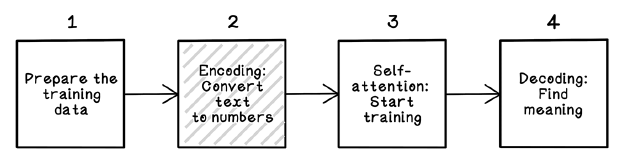
Use the workflow figure to visualize encoding as the step that changes text into numbers before model processing. section 11.8








