RDF (Resource Description Framework) is a W3C-standard graph data model for publishing, exchanging, and representing knowledge as subject–predicate–object triples. A subject and object are graph nodes; the predicate is a reusable relationship connecting them. This statement-based model supports machine-readable knowledge that remains interpretable by people and interoperable across systems. section 1.6 section 3.2
RDF is useful when a knowledge graph must preserve shared meaning across data sources:
- Standardize data publication and sharing on the web through globally defined predicates and reusable statements. section 1.6
- Construct ontologies that describe a domain and connect entities through explicit semantic relationships. section 3.2 section 3.6
- Link separate RDF graphs using federation and contextual information, supporting integration across heterogeneous systems. section 1.6
- Add context to groups of triples with named graphs when relationship-wide predicate metadata is too broad. section 3.2
Clinical phenotype annotations
A disease such as “Diabetes Mellitus, Insulin-dependent-1” can connect to “Decreased level of 1,5 anhydroglucitol in serum” through a phenotype relationship. RDF models the disease and feature as nodes, while ontology vocabularies and related metadata provide an unambiguous semantic representation. When each annotation needs its own author, date, source, and provenance, the relationship’s context must be modeled explicitly; this is a case where RDF’s global predicates require techniques such as named graphs. section 3.2.1 section 3.2
Figure 3.6 Data transformation from a table row to a KG edge. Information in the table is adapted to define the properties of nodes and edges in the KG.
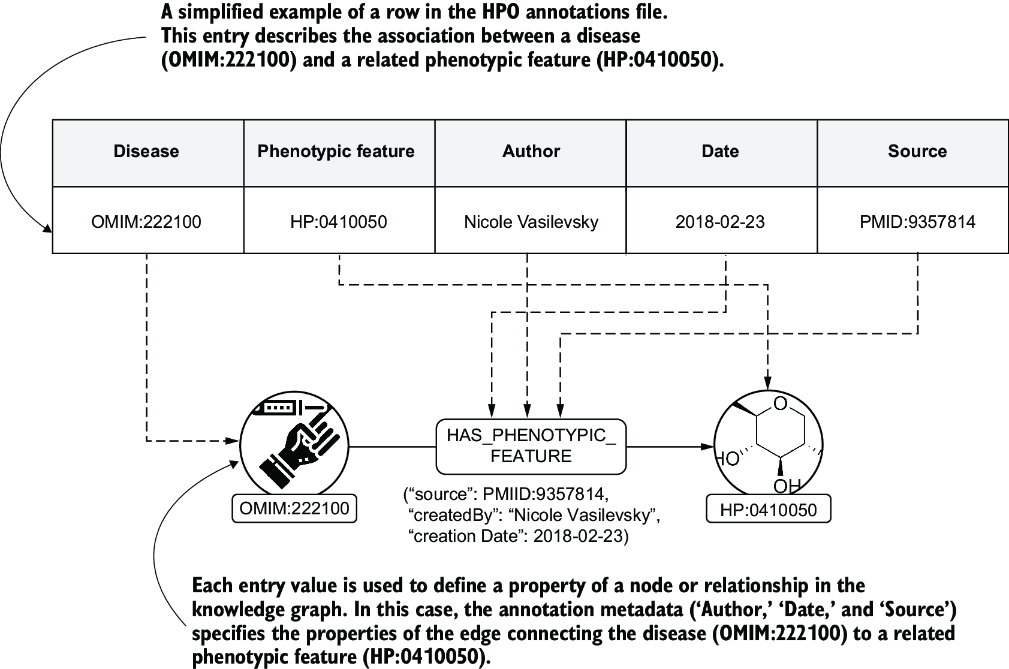
Trace how a tabular clinical annotation becomes graph data: entities become nodes, the association becomes a relationship, and annotation details become graph properties or contextual metadata. section 3.2.1
