ReadCloser is a Go interface that combines Reader and Closer, letting code read from a source and close it when processing finishes. section 10.3 section 2.8.2
Use ReadCloser when an operation must both consume data and finish with resource cleanup.
- Accepts different readable resources through one interface rather than depending on a concrete file or connection type. section 10.3
- Expresses the caller’s required capabilities: reading data and calling Close when the resource is no longer needed. section 2.8.2
- Fits Go’s compositional I/O design alongside Reader, Writer, Closer, WriteCloser, and ReadSeekCloser. section 2.8.2
Processing and closing an input
A processing function can work with a readable resource while retaining the ability to close it safely. The same interface-oriented design supports files and other I/O sources without changing the processing logic. section 10.3 section 2.8.2
Figure 10.1 io.Reader and io.Writer interface composition with multiple package implementations
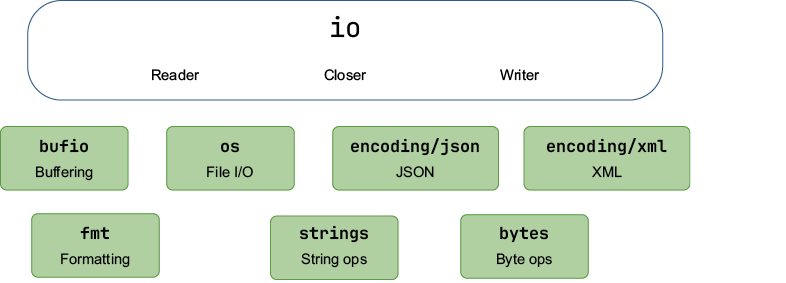
Shows how Reader and Writer interfaces compose with implementations across packages, placing ReadCloser within Go’s broader I/O abstraction model. section 10.3
