A model can answer many questions correctly yet fail when an answer depends on several linked decisions. Scaling pretraining drove major progress in AI, but did not produce dependable multi-step reasoning or planning. The engineering problem is not just retaining facts: it is applying the right relationships, in the right order, while keeping earlier steps consistent. section 6.4 section 7.5.3
Relational reasoning makes one part of that problem concrete. A question about a scene may require comparing objects, counting a subset, then selecting an answer. The Relation Network (RN) was tested on CLEVR, a synthetic visual question-answering benchmark. It reached 95.5% accuracy, with particularly strong results on comparison and counting questions; it also reached 96.4% when images were replaced by structured descriptions of object properties. Those results test reasoning over both visual and factored inputs, not dependable reasoning in every setting. section 7.2.1 section 6.4
Table 7.2 CLEVR test accuracy by question type
|
Model
|
Overall
|
Count
|
Exist
|
Compare numbers
|
Query attribute
|
Compare attribute
|
|---|---|---|---|---|---|---|
|
Human
|
92.6
|
86.7
|
96.6
|
86.5
|
95.0
|
96.0
|
|
Q-type baseline
|
41.8
|
34.6
|
41.7
|
43.7
|
52.2
|
64.4
|
|
LSTM
|
46.8
|
50.2
|
61.1
|
65.2
|
71.1
|
82.7
|
|
CNN+LSTM
|
52.3
|
51.0
|
69.8
|
67.1
|
73.5
|
77.4
|
|
CNN+LSTM+SA
|
68.5
|
36.0
|
36.8
|
49.3
|
85.3
|
82.6
|
|
CNN+LSTM+SA*
|
76.6
|
51.3
|
51.8
|
53.0
|
52.3
|
75.4
|
|
CNN+LSTM+RN
|
95.5
|
90.1
|
97.8
|
93.6
|
97.9
|
97.1
|
The CLEVR accuracy table separates counting and comparison from other question types, making the RN’s gains over contemporary baselines easier to inspect. section 7.2.1
Where did the football go?
“Sandra picked up the football” and “Sandra went to the office” together support “the office” as the answer to “Where is the football?” The bAbI tasks use supporting facts like these to test whether a model can connect events rather than answer from one sentence alone. An RN passed 18 of its 20 tasks. section 7.2.1
Sequences add a memory problem: relevant items may arrive at different times. A relational memory core (RMC) lets memory slots attend to one another and to the current input, then uses gating to retain updated information. Asked for the second-farthest vector from a reference, it must compare distances and rank candidates, not merely recall the list. The RMC reached about 91% accuracy on this task; an LSTM and a differentiable neural computer remained below 30%. The result illustrates the value of interaction within memory, without making every sequence task a solved problem. section 7.4 section 7.4.1
Figure 7.6 (a) The RMC takes the previous memory matrix and the current input and applies a multihead dot-product attention (MHDPA) module labeled A, allowing memory slots to exchange information with one another and with the input. It then refines each slot with a small feed-forward network (MLP) and writes the result through a gate to produce the output for the step and the next memory state. (b) For each memory slot and the input, the model forms queries, keys, and values, enabling multiple “heads” to view relations from different perspectives. (c) Similarity between queries and keys yields normalized attention weights, which are used to compute weighted combinations of the values. The results update the memory matrix so that each slot integrates the most relevant information from others. The MLP and gate then finalize what is retained for the next step. Used with permission granted by the lead author (Adam Santoro).
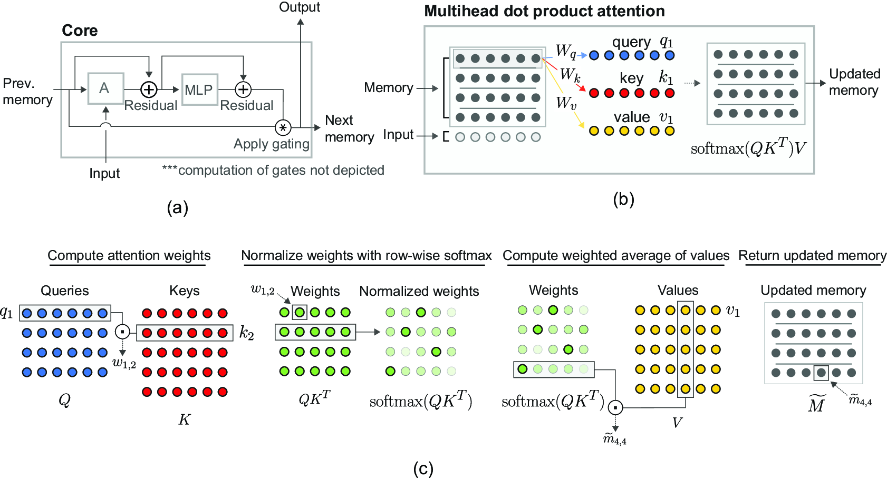
The RMC diagram shows how attention exchanges information among memory slots before a gate determines what persists to the next step. section 7.4
Language models offer another route: ask for intermediate steps before an answer. Chain-of-thought prompting guides a model to produce a natural-language reasoning trace, and improved results on math word problems and commonsense puzzles without additional training in the reported experiments. GPT-4, for example, answered about 92% of GSM8K problems correctly using few-shot chain-of-thought prompting. For a planning puzzle, explicitly listing states, legal moves, and a safety check after each move can help catch invalid steps. These are useful interfaces for tackling multi-step tasks, not guarantees that a model has a reliable world model. section 7.5.3 section 7.5









