A team appears ready to approve a proposal. One person asks for the decision, another questions its assumptions, and a third wants customer evidence. The friction may not be disagreement about the proposal: people are trying to use different reasoning structures at once. section 7.1
A reasoning architecture organizes how a conversation moves from question to conclusion. It can converge on an answer, expose intermediate logic, branch into alternatives, rotate perspectives, or test a conclusion against evidence. These are different functions, not stages every decision must pass through. section 1.0 section 1.2.1
Choose the mode that addresses the problem in front of the team:
- Direct Q&A: answer promptly when the question is bounded and stable. It adds speed but can conceal assumptions when the problem is not yet understood. section 1.2.1
- Chain-of-Thought: make assumptions, dependencies, and intermediate logic visible when a confident answer needs examination. section 7.2
- Tree-of-Thought: develop and compare distinct approaches when the first option has narrowed the search too soon. section 7.2
- Chair-of-Thought: examine the same issue from different vantage points when people are optimizing for different priorities. section 7.2
- ReAct: connect a plausible conclusion to evidence when confidence is growing without external validation. section 7.2
Figure 7.1 The reasoning models form a stack of increasing structure. Each layer adds a distinct capability, allowing teams to calibrate the depth of reasoning to the complexity and uncertainty of the problem being solved. Use only the layers required by the problem.
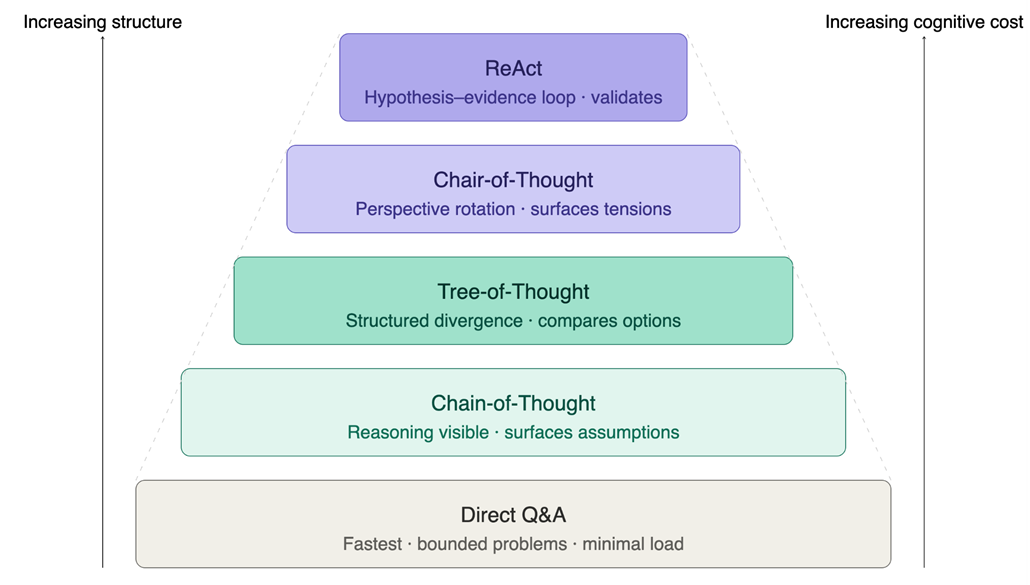
The stack shows what each added layer contributes. Add only the structure the problem needs; move between modes as the problem changes. section 7.2 section 7.8
A quick check can locate the mismatch: Is the question bounded? Have we named our assumptions? Are there multiple viable paths? Are different perspectives optimizing for different things? What evidence would change our minds? Fast agreement may signal compressed reasoning; persistent conflict may signal a perspective mismatch. Neither signal proves the diagnosis on its own. section 7.3
Make the smallest useful intervention: ask for the assumption behind a recommendation, briefly compare alternatives, or pause to identify decisive evidence. More process is not automatically more reasoning. Even a well-chosen mode can fail when status pressure keeps assumptions private, time pressure cuts exploration short, or contradictory evidence is dismissed. The thinking environment must let people use the structure honestly. section 1.2.2 section 7.7