A team sees activation falling and asks, “What’s the fastest way to turn this around?” It agrees to accelerate onboarding. The decision creates motion, but the team has not checked whether onboarding caused the decline; pricing, messaging, or targeting might also explain it. The answer may be reasonable. The question has simply narrowed the search before anyone tested its frame. section 2.1 section 2.3
Direct Q&A moves from a question to an answer in one visible step. Reasoning still happens, but framing choices, assumptions, constraints, trade-offs, alternatives, and confidence levels usually remain private. Agreement on the answer therefore need not mean agreement on why it is right or what it requires. Fast conclusions can conceal different interpretations that emerge only during execution. section 2.1.1 section 2.3
Use the pattern when the question is bounded and stable: “Has the deployment completed?” needs a status, not a workshop. It also suits urgent stabilization, readily reversible actions with short feedback loops, and familiar situations where expertise has been calibrated by repeated feedback. In those settings, elaborating the reasoning can cost more than it adds. section 1.2.1 section 2.4
Watch for unusually quick agreement on a complex issue, no visible alternatives, repeated rework, or disagreement over implementation. Speed and confidence can look like alignment while people are answering different questions. Direct Q&A is more dependable when scope is clear, people can speak candidly, success criteria are shared, and feedback exposes mistakes soon enough to correct them. section 2.7 section 2.3
Keep the exchange fast, but add only the check the decision needs:
- If the question may already contain a diagnosis, ask: “What do we believe is driving this?” section 2.5
- If the answer depends on an unspoken premise, ask: “What assumptions are we making?” section 2.5
- If the first answer is becoming the only answer, ask for two other plausible approaches before choosing. section 2.5
If those checks reveal consequential uncertainty, change the reasoning mode rather than extending the meeting by default. Make intermediate logic visible with Chain-of-Thought; compare distinct paths with Tree-of-Thought; examine different perspectives with Chair-of-Thought; or test a conclusion against evidence with ReAct. Select the smallest addition that fits the problem. section 7.2 section 2.5
Figure 7.1 The reasoning models form a stack of increasing structure. Each layer adds a distinct capability, allowing teams to calibrate the depth of reasoning to the complexity and uncertainty of the problem being solved. Use only the layers required by the problem.
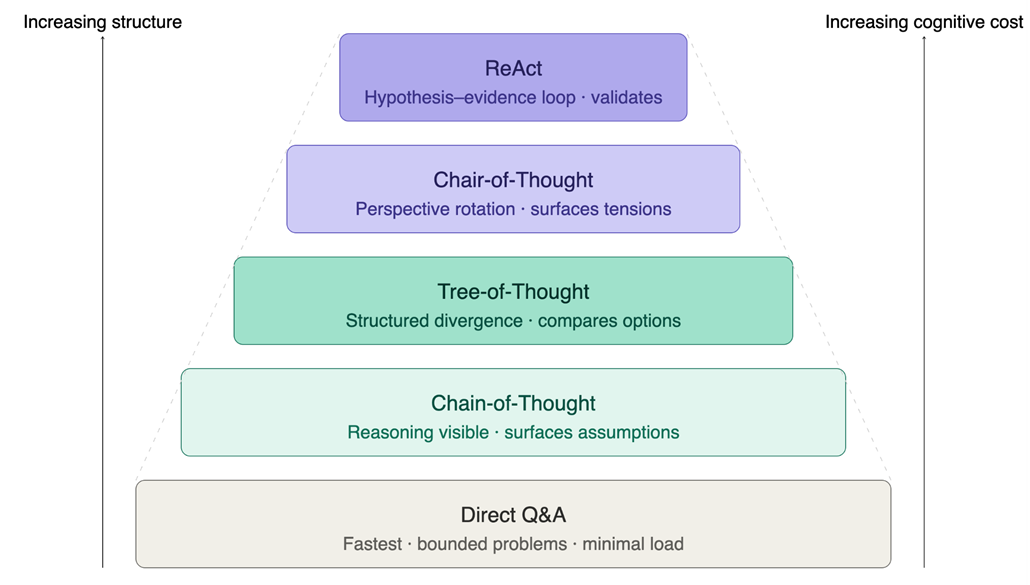
The stack shows Direct Q&A as the fast base layer and the distinct capabilities added when a problem needs more structure. section 7.2