A leadership team agrees to “reduce onboarding friction” and leaves confident it has made a clear decision. Product means fewer customer-journey steps; Sales means faster time to first value; Operations means fewer manual handoffs; Finance means lower support costs. The agreement is visible, but the reasoning and intended outcomes differ. section 2.3
This is silent divergence: people agree on a conclusion while holding different assumptions about what it means or how it will play out. Compressed reasoning leaves participants to reconstruct the steps themselves, and those reconstructions may not match. section 2.3 section 3.3.1
Make the reasoning inspectable before committing: state the intermediate steps and surface assumptions so participants can evaluate the logic rather than guess at it. This adds structure without requiring a lengthy process, and helps reveal misalignment while it is still inexpensive to address. section 3.3.1 section 2.8
Figure 3.2 Expanding reasoning into explicit steps transforms how groups think: assumptions surface, causality becomes testable, disagreement becomes precise, and errors are detected earlier rather than downstream.
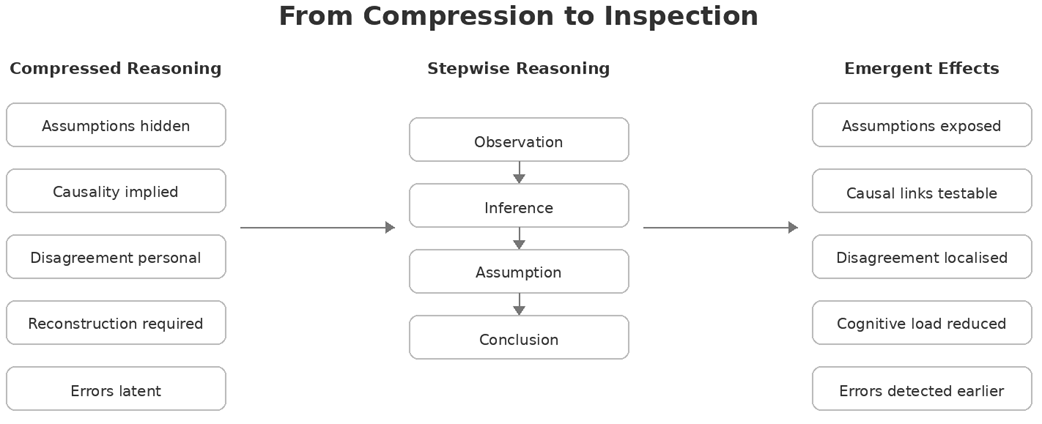
The figure shows how explicit reasoning can surface assumptions, make disagreement precise, and expose errors earlier. section 3.3.1