A reasoning model is a language model improved through training or prompting to generate intermediate problem-solving steps before its final answer. These steps may be visible, hidden in special tags, or omitted from the user-facing response. The practical goal is to improve performance on complex coding, mathematics, and logic tasks rather than to claim human-like thought. section 1.1
Use reasoning models as an engineering component when the task justifies their additional computation:
- Apply chain-of-thought or other inference techniques when a task benefits from explicit intermediate steps, decomposition, planning, or tool selection. section 1.1 section 1.6
- Prefer conventional models for simpler summarization, translation, or knowledge-based questions when longer outputs, higher cost, latency, or overthinking are poor trade-offs. section 1.6
- Distinguish deliberate reasoning behavior from implicit pattern matching: a conventional model can appear logical without explicitly tracking contradictions or applying rules. section 1.5
Math verification workflow
A model generates a free-form solution and final answer, a verifier extracts and normalizes that answer, and an external calculator or code interpreter compares it with the reference solution. The resulting correctness signal can evaluate performance and later support reinforcement-learning training. section 3.1
Figure 1.9 A high-level road map of what we’ll build in this book. We’ll start with a conventional LLM, add evaluation methods so we can measure its progress, and then explore two broad families of reasoning improvements: inference techniques and training techniques.
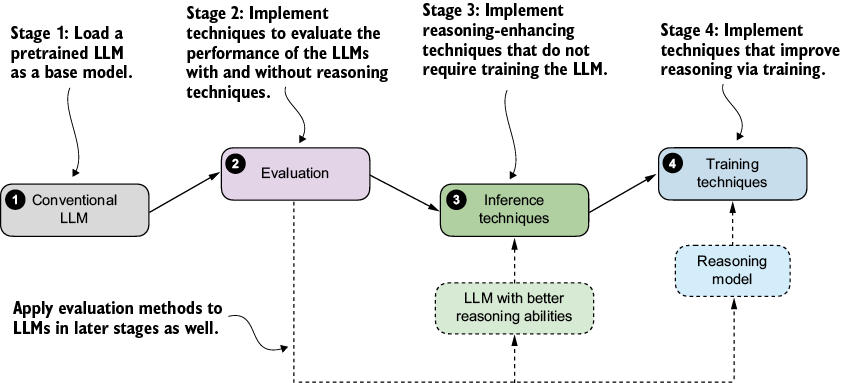
Use the roadmap to trace the build from a pretrained base LLM through evaluation, inference-time improvements, and training-time methods that produce a dedicated reasoning model. section 1.7



