A reasoning pattern is a recurring strategy for multi-step inference or problem solving. In language-model training, models can acquire such patterns through reinforcement learning, synthetic examples, or distillation rather than relying only on explicit human instruction. section 1.2.3
Reasoning patterns emerge through a staged training process:
- Begin with a capable pretrained base and a small cold-start dataset. section 1.2.3
- Use pure reinforcement learning to explore problem-solving strategies through trial and error. section 1.2.3
- Generate multiple candidate responses, retain stronger outputs through rejection sampling, and reuse them as synthetic training data. section 1.2.3
- Blend synthetic outputs with supervised examples before applying final reinforcement learning across diverse tasks and formats. section 1.2.3
The base model determines how readily a pattern is absorbed. A model with prior mathematical knowledge can learn mathematical reasoning more effectively, while smaller models may repeat text instead of sustaining long reasoning chains. section 8.7.3
Distilling reasoning into smaller models
A large teacher model generates high-quality reasoning data for smaller student models. Distilled checkpoints from 1.5B to 70B parameters demonstrate the practical trade-off between inherited reasoning capability and computational efficiency. section 1.2.3
Figure 1.6 The multi-step post-training pipeline used to create DeepSeek-R1 from the DeepSeek-V3 base model. This process involves a combination of reinforcement learning (Pure RL), data generation (Rejection sampling), and fine-tuning to instill advanced reasoning capabilities.
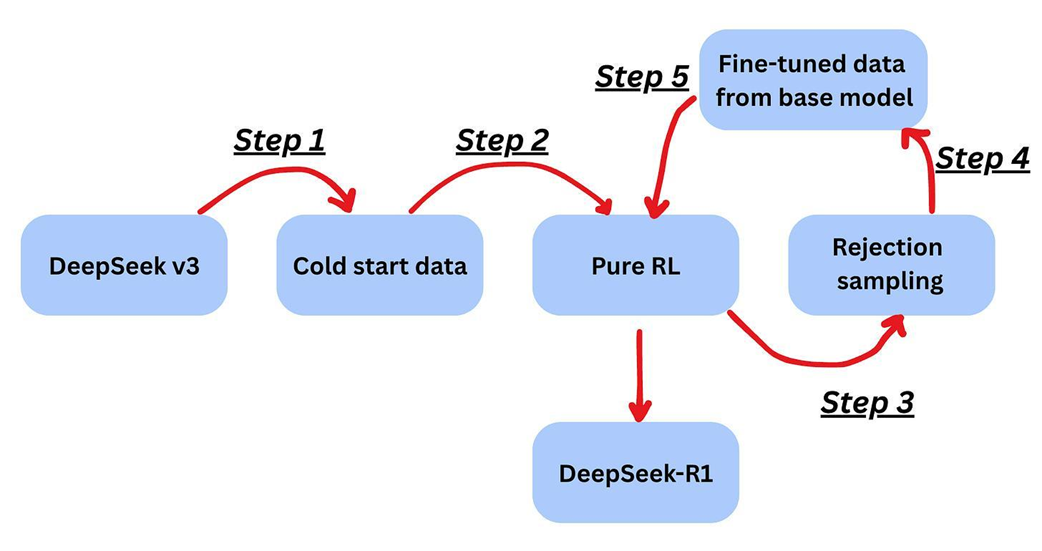
Trace the multi-step pipeline from a lightly fine-tuned base through pure reinforcement learning, rejection sampling, data blending, and final reinforcement learning. section 1.2.3
