Recency-based memory is tabu search’s short-term memory: it records recently visited moves or search attributes and temporarily prevents their reuse. Unlike memoryless local search, it gives the search an explicit history, helping avoid immediate revisits and cycles while exploring neighboring solutions. section 6.2.1
A practical tabu-search cycle uses the memory as follows:
- Record the move or attribute used during the current transition. section 6.2.1
- Mark that move tabu for a limited tabu tenure, measured as the number of iterations before reuse is allowed. section 6.2.1 section 6.2.3
- Adjust the tenure when necessary: short tenures can permit repeated moves too quickly, while long tenures can cause stagnation, larger memory requirements, and slower computation. section 6.2.3
Four-city traveling-salesperson search
A tabu structure for a four-city traveling-salesperson problem can store remaining tabu iterations for active moves. As iterations pass, those counts expire, allowing previously restricted moves to re-enter the neighborhood. The same structure can be contrasted with frequency-based memory, which counts how often moves have been used across the full search. section 6.2.1
Figure 6.7 Dynamically controlling the tabu tenure
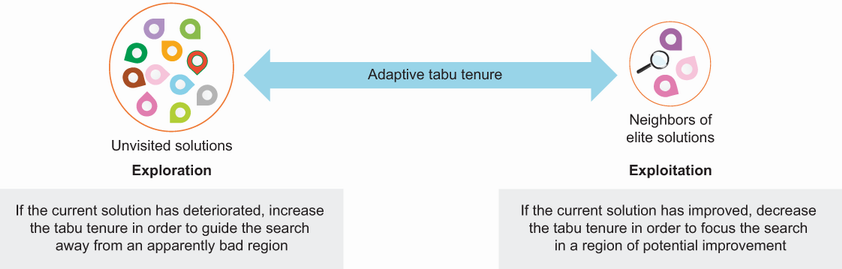
Use the dynamic-tenure figure to compare intensification near improving solutions with diversification away from deteriorating or stagnant regions. section 6.2.3
