liveBook · Manning

Receiver

As explained in Algorithms Every Programmer Should Know

A receiver is a participant on the side that evaluates and tentatively accepts or rejects proposals in a two-sided matching procedure.

In a two-sided matching procedure, a receiver evaluates proposals using its ranked preferences. It may accept a proposal provisionally, reject it, or replace its current match when a more preferred option arrives. section 2.0 section 2.1.2

Receivers do not control who proposes, so the proposing side tends to get more favorable matches. The roles can be reversed, changing which side has that advantage. section 2.1.3 section 2.1.2

Figure 2.2 The receiver's preference list is checked, where Alice prefers X, Bob prefers Y, and Carol prefers Z. Final matching is completed once all students accept the proposal.
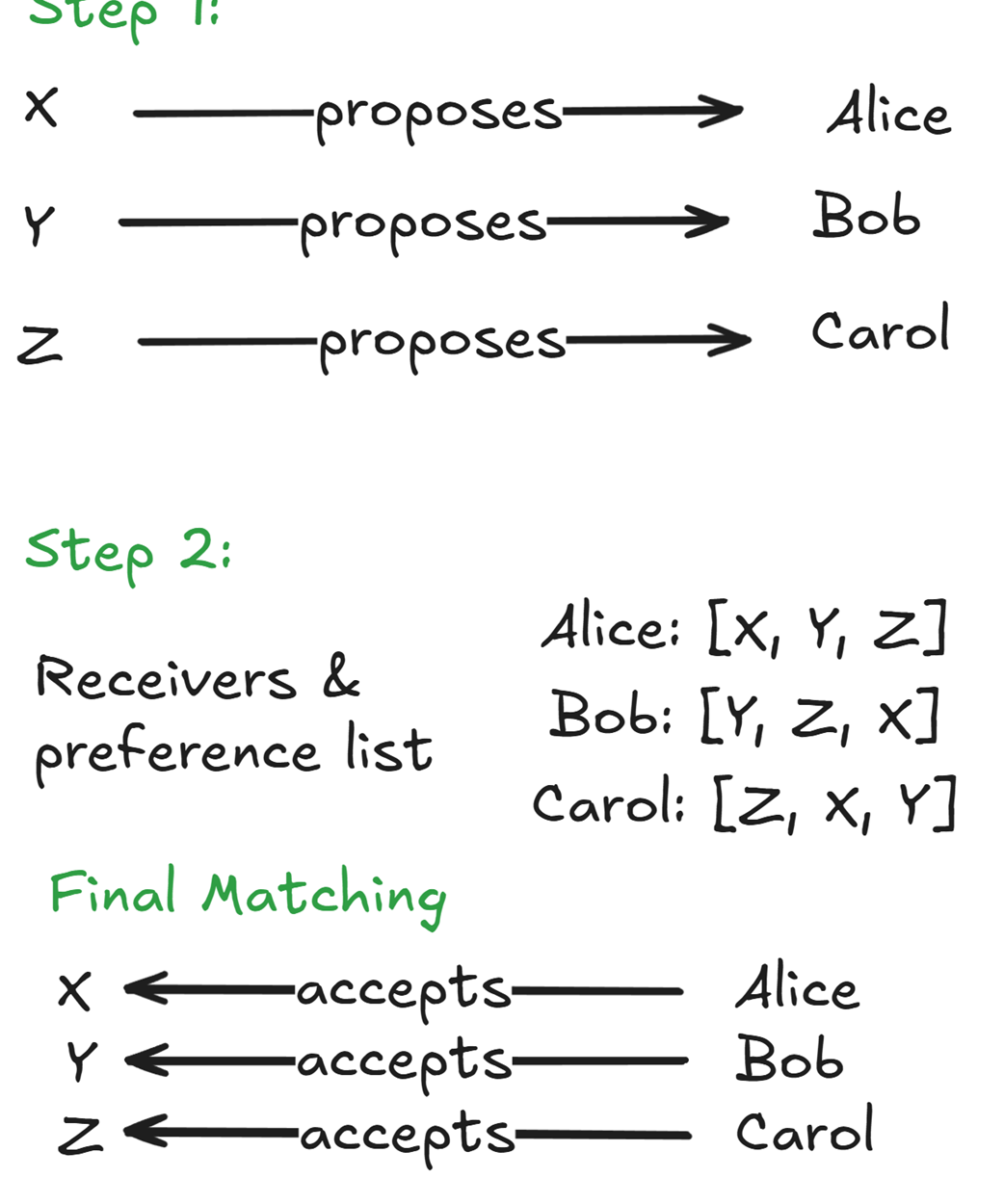
The figure traces how receivers check proposals against their preferences and accept a match. section 2.1.1

How Algorithms Every Programmer Should Know covers it

How deep it goes
Traces temporary acceptance, rejection, and replacement through examples, then discusses proposer advantage without formal proofs.
Examples
Uses universities receiving student proposals, including conflicts where universities retain preferred applicants and reject others.
What it assumes
Uses ranked preferences for both participant groups to explain receiver decisions.
What you can do after
Understand how receiver preferences determine provisional matches and why receivers have less control over outcomes.
How it connects
Connects receivers to deferred acceptance, stable matching, and proposer-side advantage.

Related concepts

This explainer was generated by Manning's knowledge graph from the text of Algorithms Every Programmer Should Know. The section links point to the parts of the book it draws on.