Reconstruction produces an output intended to match an original input after information passes through a compressed representation. Because compression removes degrees of freedom, reconstruction is generally approximate and lossy: it preserves salient structure while discarding subtle variation. section 10.5.1 section 9.1.4
In an autoencoder, an encoder maps an input to a smaller embedding, while a decoder maps that embedding back to a reconstructed input. Training minimizes the mismatch between the original and reconstructed tensors, commonly with Euclidean distance or binary cross-entropy. section 10.5.1 section 9.1.4
The reconstruction workflow connects representation size, loss, and model architecture:
- Compress the input into an embedding with fewer degrees of freedom. section 10.5.1
- Expand the embedding into a tensor with the input's size, using transposed convolutions when appropriate. section 10.5.1
- Measure the difference between input and output, then optimize encoder and decoder weights to reduce it. section 10.5.1 section 9.1.4
For normalized image or vector values in [0, 1], binary cross-entropy compares each input element with its reconstruction. Summing over pixels gives a reconstruction objective whose minimum occurs when the output matches the input, although the loss need not equal zero there. section 9.1.4
PCA reconstruction
A three-dimensional dataset can be centered, projected onto two principal directions, padded back to three dimensions, and transformed through the principal-direction matrix. The resulting points approximately reconstruct the originals because the discarded dimension contains lost information. section 14.4.1
Figure 14.7 Geometric depiction of VAE latent-space modeling distributions
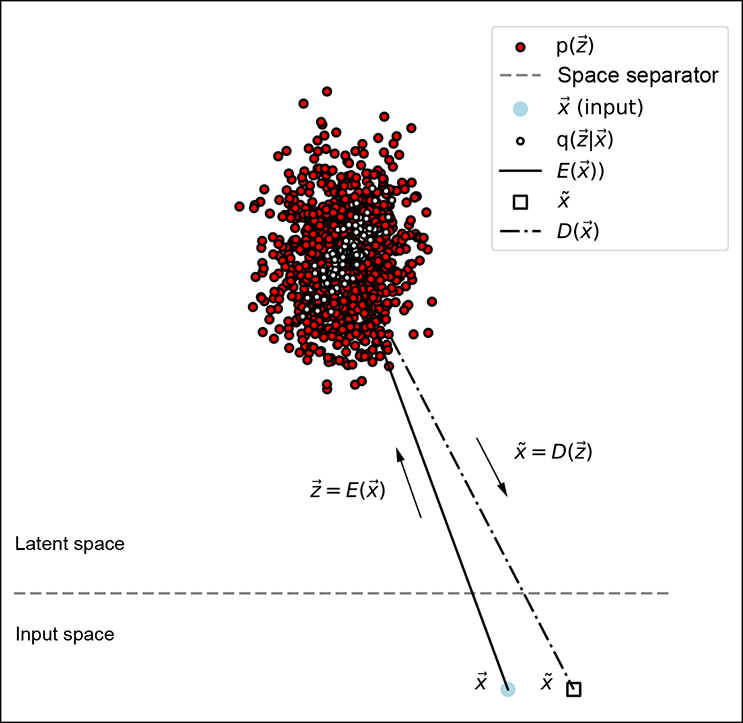
A geometric view shows a VAE decoder mapping a latent vector back into input space as a reconstructed point. section 14.7.1
