A recursive route specifies a destination and a next-hop IP address, but no outgoing interface. The router must use that next-hop address to determine where to forward packets. section 9.3.2
Distinguish route types by what they specify:
- A recursive route specifies only the next-hop IP address. section 9.3.2
- A directly connected route specifies only the exit interface. section 9.3.2
- A fully specified route specifies both the next-hop IP address and exit interface. section 9.3.2
Cisco static-route example
The command ip route 10.0.0.0 255.0.0.0 192.0.2.1 creates a network route and a recursive route: 10.0.0.0/8 is the destination network, and 192.0.2.1 is the only specified next hop. section 9.3.2
Figure 9.11 R1 has two routes to specific destination networks and one default route to the internet. (1) A route to 192.168.2.0/24, with R2 G0/0 as the next hop. (2) A route to 192.168.3.0/24, with R3 G0/0 as the next hop. (3) A default route, with the ISP’s IP address (203.0.113.2) as the next hop.
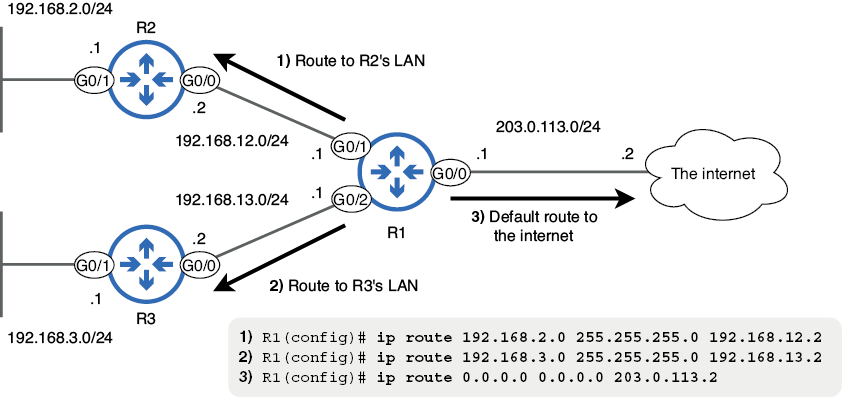
Compare recursive static routes to 192.168.2.0/24 and 192.168.3.0/24 with a recursive default route using the ISP’s next-hop address. section 9.3.2
