Red-teaming deliberately challenges an AI system to expose weaknesses that automated tests may miss. The aim is to find vulnerabilities before users do, not to break the system for its own sake. section 9.1.5
ShopBot failure probes
A red team might try to elicit an incorrect refund policy, an invented product, an impossible delivery promise, or internal business information. section 9.1.5
Use red-teaming as a repeating improvement cycle:
- Test adversarial prompts, extreme scenarios, and edge cases. section 9.1.5
- Analyze discovered weaknesses for their causes and implications. section 9.1.5
- Improve the system and test it again; repeat the cycle to build reliability. section 9.1.5
Red-teaming complements, rather than replaces, metrics and standard evaluations: each can reveal different failure modes. In production, combine evaluation approaches to assess reliability as systems and usage change. section 9.1.5 section 1.4.3
Figure 9.2 The red-teaming process for LLMs
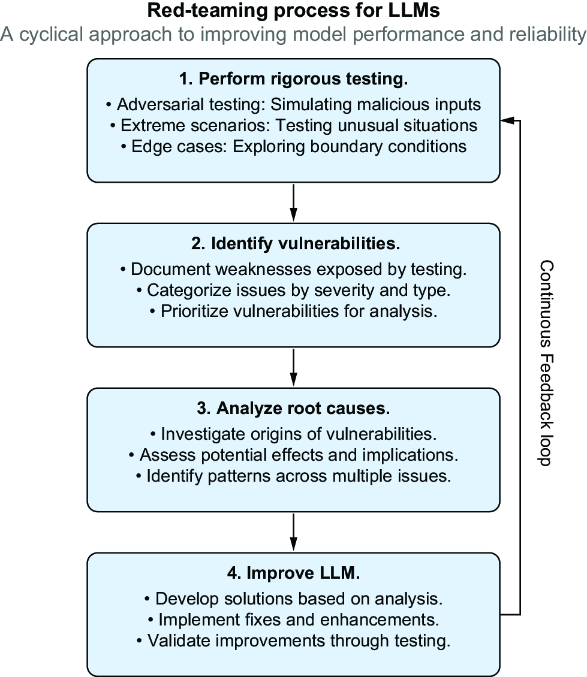
See the testing, analysis, and refinement cycle. section 9.1.5





